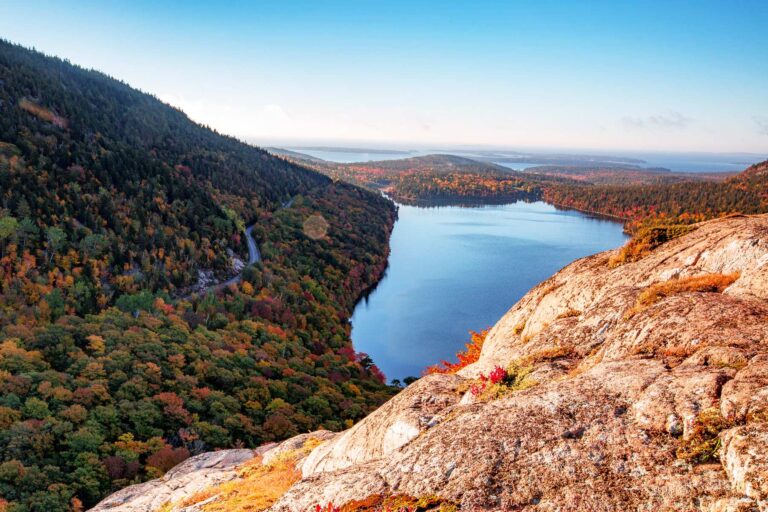


Acadia National Park protects more than 47,000 acres of the Maine coast on Mount Desert Island, the Schoodic Peninsula and Isle au Haut. It is known for Cadillac Mountain, where from October 7 to March 6 the sun rises first in the country, for 45 miles of carriage roads given by John D. Rockefeller Jr., and for more than 1,100 plant species.
No act of Congress carved Acadia National Park out of land the government already owned. There was nothing to carve. Every acre of the first national park east of the Mississippi River was bought, pieced together, and handed to the American people by private citizens, one of whom spent his family fortune doing it and then served as the park’s first steward for a salary of one dollar a month.
What follows are 12 facts about Acadia, the people who gave it away, and the rocky Maine coast they saved. For trip planning, trails, and the current Cadillac Summit Road vehicle reservation rules, start with our full Acadia National Park guide.
Tony Pattiz taught American history for more than 25 years before he began writing it for this site. Every date, number, and name below has been checked against the National Park Service and the primary sources listed at the end of this article. Last verified July 2026.
Love Acadia? It's one of 117 threatened public lands destinations we're tracking. Get the free briefing.
Acadia National Park Basics
- Location: The Maine coast, spread across Mount Desert Island, the Schoodic Peninsula, and Isle au Haut
- Size: 35,332 acres owned by the National Park Service plus 12,416 acres of private land under conservation easements, more than 47,000 acres in all, per the NPS park fact sheet
- Visitation: 4,079,318 recreation visits in 2025, the busiest year in the park’s history, per NPS Stats
- Highest point: Cadillac Mountain, 1,530 feet
- Established: Sieur de Monts National Monument on July 8, 1916; Lafayette National Park on February 26, 1919; renamed Acadia National Park on January 19, 1929
- Claim to fame: The first national park east of the Mississippi River, and still the only national park in New England
1. People Have Lived In The Dawnland For More Than 12,000 Years
Long before any explorer wrote a name on a map, this coast was home. The National Park Service dates human presence in the place we now call Acadia to more than 12,000 years, and the Wabanaki Nations, the Maliseet, Micmac, Passamaquoddy, and Penobscot, still live here today. Wabanaki means People of the Dawnland, a fitting name for the people of the coast that greets America’s first light. Generations ago they traveled these waters in seaworthy birchbark canoes, and their governments deal with the park on a government-to-government basis; since 2015 the Park Service has worked toward renewed gathering of certain traditional plants within park boundaries.
Want to go deeper? The Abbe Museum in Bar Harbor, Maine’s only Smithsonian Affiliate, holds the largest and best documented collection of Maine Native American basketry in any museum, and it tells Wabanaki history in Wabanaki voices.

2. Samuel De Champlain Named Mount Desert Island In 1604
Sixteen years before the Pilgrims landed at Plymouth, a French expedition under Samuel de Champlain sailed along this coast and took note of an island whose mountains rose straight from the sea, bald granite on top.
The mountain summits are all bare and rocky … I name it Isles des Monts Deserts.
Samuel de Champlain’s journal, 1604
The island of bare mountains. Four centuries of mapmakers kept the name, and Mount Desert Island it remains. Champlain’s visit put this coast on course to become part of New France before it ever became New England, which is why so much of the park’s story, from its name to its highest peak, carries a French accent.
3. The Name Acadia Probably Comes From A Mi’kmaq Word
For years, travel writers, this site once included, repeated the story that Champlain’s countrymen called the region Acadia because it meant heaven on earth. The Park Service tells a different and better story. According to the NPS, the term derives from descriptions first carried back to France by fishermen and traders in service to King Henry IV, and many believe it traces to the Mi’kmaq word akadie or cadie, meaning a piece of land, generally a good one.
The Native lineage of the name mattered when it was chosen. In 1929, NPS Director Stephen T. Mather emphasized that in renaming Lafayette National Park the government was embracing a term in use before recorded French or English exploration of the area. The oldest name on this coast, in other words, won.
4. Acadia Was The First National Park East Of The Mississippi River
Every national park that existed before 1919 sat in the American West. Acadia broke the pattern. According to the Library of Congress, the park established in 1919 was the first national park east of the Mississippi River, the first on a coast, and the first created from land donated by private individuals.
It arrived in three acts. President Woodrow Wilson used the Antiquities Act to proclaim Sieur de Monts National Monument on July 8, 1916. Full park status came on February 26, 1919, under the name Lafayette National Park, honoring the French general of the American Revolution. On January 19, 1929, the park took its permanent name, Acadia. More than a century later it is still the only national park in New England.

5. One Man Spent His Fortune Buying The Park Into Existence
So who did the donating? The answer, more than anyone else, is George Bucknam Dorr, a Boston-born heir who first visited Mount Desert Island on a family vacation in 1868 and never really left. As a retired history teacher, I find his story hard to beat. He is the reason people call Acadia the park that was given away.
A Fortune Turned Into A Park
In 1901, alarmed by Bar Harbor’s rapid development and the newly invented portable gasoline sawmill, Dorr, Harvard president Charles W. Eliot, and other summer residents formed the Hancock County Trustees of Public Reservations to hold land for free public use. By 1913 the Trustees had assembled roughly 6,000 acres, with Dorr donating parcels of his own land and spending much of his inheritance to buy more. When opponents in the Maine legislature moved to revoke the Trustees’ charter that year, Dorr went to Augusta and defeated the measure himself.
A Dollar A Month, For Life
Convinced only federal protection could make the preservation permanent, Dorr offered the Trustees’ land to the government, and Wilson created the national monument in 1916. Dorr declined any salary except one dollar a month as its first custodian, then served as the national park’s first superintendent from 1919 on. He never retired. His beloved Old Farm estate was accepted as park property one month before the attack on Pearl Harbor, and Dorr died on August 5, 1944, having given nearly everything he had to the park he is remembered for, as the Father of Acadia.

6. Rockefeller Built The Carriage Roads And Financed 16 Of Their 17 Stone Bridges
Dorr assembled the land. John D. Rockefeller Jr., who bought a summer home in Seal Harbor in 1910, gave the park its most famous man-made feature. A skilled horseman who wanted to travel his island free of automobiles, Rockefeller spent the years from 1913 to 1940 building a 57 mile system of motor-free broken-stone roads, of which 45 miles of carriage roads weave through the park today.
He did not just write checks. Rockefeller walked the staked alignments, watched the work, and financed 16 of the 17 stone-faced bridges that carry the roads over streams, waterfalls, and cliffsides, each one unique in design. Landscape gardener Beatrix Farrand consulted on the plantings that frame the bridges and vistas. The roads run about 16 feet wide, and the rough granite guardrail blocks lining them earned an affectionate nickname that stuck, Rockefeller’s teeth.
7. The Fire Of 1947 Remade Mount Desert Island
On the afternoon of October 17, 1947, a caller reported smoke rising from a cranberry bog near Dolliver’s dump on Crooked Road. The fire that grew from that bog burned for weeks. By the end, 17,188 acres had burned, more than 10,000 of them inside Acadia National Park, and property damage exceeded 23 million dollars. The flames destroyed 67 of the grand seasonal estates on Bar Harbor’s Millionaires’ Row along with 170 permanent homes and five historic hotels.
Two crews, one hired by the park and one by the Rockefeller family, salvaged timber and cleaned up afterward. Then something interesting happened. The spruce and fir forests that had reigned before the fire gave way to sun-loving trees such as birch and aspen, which is why Mount Desert Island now erupts in yellows and reds every October. The fall color that draws so many visitors is, in part, the fire’s legacy.

8. Cadillac Mountain Catches America’s First Sunrise For Five Months Of The Year
You may have heard that Cadillac Mountain sees the first sunrise in the United States. The claim is true, but only part of the year. According to the NPS, from October 7 to March 6 the 1,530 foot summit, the highest point on the eastern seaboard of the United States, is the first place in the country you can watch the sun come up. In the warmer months, that honor shifts to points farther east in Maine. And no, Cadillac is not the tallest mountain on the East Coast; peaks far inland, like North Carolina’s Mount Mitchell, stand much higher. Cadillac’s distinction is height directly above the Atlantic.
The name has a story too. It honors Antoine de la Mothe Cadillac, a self-invented French adventurer granted a tract including Mount Desert Island in 1688, who went on to establish the fort that became Detroit and to serve, unhappily, as governor of Louisiana. Green Mountain was renamed for him in 1918. You can drive to the summit on a road built between 1924 and 1931, or earn it on foot; our guide to the best hikes in Acadia National Park covers the trails.
9. One Of The Smallest National Parks Is Also One Of The Busiest
At just over 47,000 acres counting conservation easements, Acadia is among the smallest of America’s national parks by area. Its crowds tell a different story. In 2025 the park logged 4,079,318 visits, the busiest year in its recorded history and only the second time, after 2021, that Acadia has crossed the four million mark.
That puts a park you can drive across in under an hour in the same visitation league as giants many times its size; see where it lands on our list of the most visited national parks. July and August are the peak months. The upside of small and busy is that a short walk away from any parking lot still buys you solitude, even in leaf season.

10. No Sitting President Visited Until Barack Obama In 2010
For all its fame, Acadia waited nearly a century for a presidential visit. President Barack Obama became the first sitting president to visit the park when he vacationed there with his family in July 2010, hiking on Cadillac Mountain, cycling the carriage roads, and stopping at Bass Harbor Head Light.
Here is the asterisk historians love. President William Howard Taft traveled to Mount Desert Island in 1910, a full century earlier. Why doesn’t he count? Because in 1910 there was no park to visit. The land did not become even a national monument until 1916, so Taft was simply a president on vacation in Maine, and the first-visit honor stayed unclaimed for another hundred years.
11. The Real James Bond Got His Start Watching Acadia’s Birds
James Bond was a real person, an American ornithologist, and his story begins on Mount Desert Island. Bond summered on the island with his uncle, the painter Carroll Tyson, and later credited his Maine summers with setting him on the path to ornithology. In 1941 the two published a guide called The Birds of Mt. Desert Island, Acadia National Park, Maine. Bond’s masterwork, though, was Birds of the West Indies, first published in 1936 and the definitive Caribbean field guide for decades.
That book sat on the desk of a writer in Jamaica named Ian Fleming, an avid birder himself. Fleming wanted, he told The New Yorker in 1962, the simplest, dullest, plainest-sounding name he could find for his fictional secret agent, and he lifted the author’s name outright, as Smithsonian Magazine recounts. So a birder shaped by Acadia’s shoreline gave his name to cinema’s most famous spy. For more park-and-Hollywood crossovers, see our roundup of movies filmed in the national parks.
12. More Than 1,100 Plant Species Grow In The Park
Acadia sits on a botanical border, where northern boreal forest meets eastern deciduous forest, and the mix is extravagant for a park this size. The NPS counts more than 1,100 plant species here, from spruce, fir, cedar, and pine to oaks, maples, and beeches, with about 25 state-listed rare plants among them. Nearly a quarter of the park’s flora is non-native, a number the park’s botanists watch closely.
The animals match the variety. White-tailed deer, snowshoe hare, red foxes, beavers, and bobcats work the forests and wetlands, eight species of bats hunt the night air, and seals, porpoises, and whales feed in the cold water offshore. Few national parks let you scan for whales in the morning and moose sign in the afternoon.

What First Light Feels Like On The Granite Coast
Facts only carry you so far, so here is what the cameras could not fully hold. On an October morning in Acadia you are cold before you are anything else, hands jammed in pockets while the sky over the Atlantic goes from black to deep blue. Then the light arrives, and it hits the granite before it hits anything green, so the whole coast glows pink and orange while the spruce below is still in shadow. That autumn ruined every other autumn for them.
If you want the same mornings, our guide to the best things to do in Acadia National Park covers where to be at sunrise and what to do with the rest of the day.
Watch Our Acadia Film
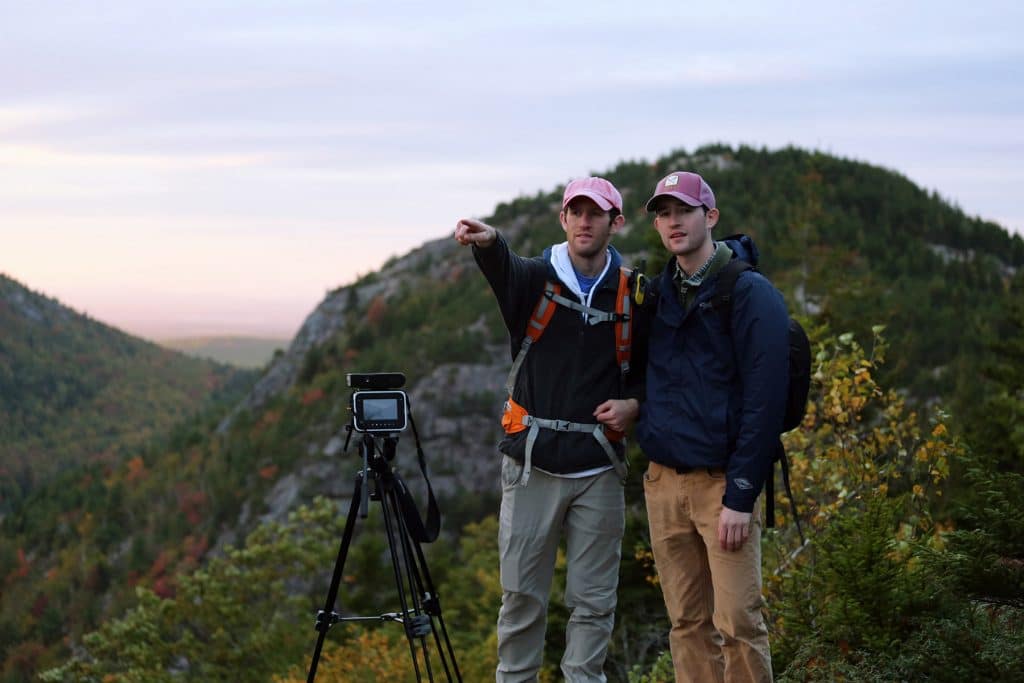
Will and Jim made MTJP | Acadia for the park’s 2016 centennial. The film follows the color inland to beaver ponds and glacier-carved valleys, out to the lighthouses that warn boats off the rocks, and up to the granite summits at first light. They dedicated it to George Dorr, without whom there would be nothing to film.

Where These Facts Come From
Every claim in this article was checked against the sources below in July 2026. Numbers that change over time, like annual visitation, are stated with the year they were reported.
- NPS, Acadia Park Fact Sheet, for acreage, easements, and establishment dates
- NPS Stats (IRMA) and Maine Public, January 2026, for the record 2025 visitation
- NPS, Wabanaki Nations and NPS, Acadia History and Culture, for the Dawnland facts
- Abbe Museum, for its collections and Smithsonian affiliation
- NPS, A History of Acadia, for Champlain’s 1604 journal and the founding timeline
- NPS, Acadia Frequently Asked Questions, for the origin of the name Acadia
- Library of Congress, Maps of Acadia National Park, for the park’s firsts
- NPS, George B. Dorr and National Parks Traveler, for Dorr, the Trustees, and Lafayette National Park
- NPS, Acadia’s Historic Carriage Roads and the Federal Highway Administration, for the carriage road system
- NPS, The Fire of 1947, for the fire’s dates, losses, and aftermath
- NPS, Cadillac Mountain and NPS, Antoine de la Mothe Cadillac, for the summit and its name
- The White House archives and ABC News, for the 2010 presidential visit; Smithsonian Magazine, for the real James Bond; NPS, Plants and NPS, Mammals, for the species facts
Keep Exploring Acadia
- Acadia National Park Guide, our full trip planning hub, including current reservation and fee information
- Best Things To Do In Acadia National Park
- The Precipice Trail, the park’s most thrilling climb
- Maine National Park Sites Worth Visiting
- Great Smoky Mountains National Park Facts, more history from the East’s great parks
- Before you go, check live alerts and air quality on our national park conditions dashboard
What to Bring to Acadia
Gear we recommend for Acadia. Affiliate links support our work at no cost to you.
More Than Just Parks may earn a small commission from purchases made through these links, at no extra cost to you. We only recommend gear we would actually use.
Affiliate disclosure: Some links on this page earn us a small commission at no extra cost to you. We only recommend gear we actually use.
More Than Just Parks Film Watch our film of Acadia We spent weeks in Acadia, one of our favorite public lands destinations, capturing it the way it deserves. Take a few minutes and see it for yourself.