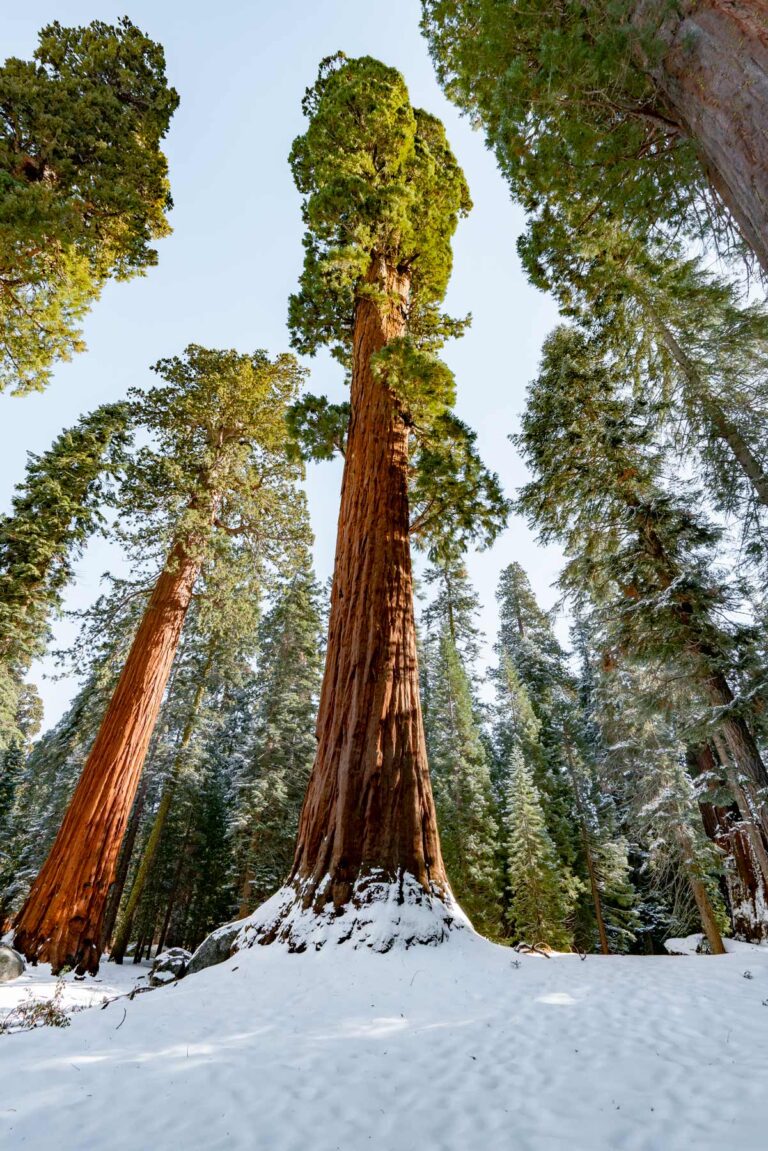


In the Grant Grove section of Kings Canyon National Park stands the General Grant Tree, the second-largest tree on Earth measured by trunk volume. It is also the only tree in the country with two formal honors to its name: it is the Nation’s Christmas Tree, and it is a living National Shrine to America’s war dead.
This guide covers how big the tree is, the unusual story behind its two designations, the annual Trek to the Tree, and how to visit.

How Big Is the General Grant Tree?
The General Grant Tree is the largest giant sequoia in Grant Grove and the second-largest tree in the world by volume, behind only the General Sherman Tree in nearby Sequoia National Park. According to the National Park Service, it stands about as tall as a 16-story building.
- Height: about 267 feet
- Base diameter: about 29 feet
- Estimated trunk volume: roughly 46,600 cubic feet
- Estimated age: roughly 1,500 to 2,000 years
- Species: giant sequoia (Sequoiadendron giganteum)

RELATED: The General Sherman Tree, the largest tree in the world by volume
117 public lands destinations are under threat. Get the free briefing that 27,000+ people use to stay informed and take action.
How the General Grant Tree Got Its Name
The naming story is not without dispute. The lumberman Joseph Thomas Hardin is said to have come upon the tree in 1862 and named it for the Civil War general Ulysses S. Grant. Many park historians instead credit Lucretia P. Baker, who camped near the tree with her family in August 1867. Whoever first spoke the name, there is no debate about who it honors: the victorious Union general who became the 18th president of the United States.

The Nation’s Christmas Tree
The story goes that a young girl, looking up at the giant sequoia, said it would make a wonderful Christmas tree. Local Chamber of Commerce leaders nearby took the idea and ran with it, and the first Trek to the Tree was held the following year. The idea climbed all the way to the White House. On April 28, 1926, President Calvin Coolidge declared the General Grant Tree the Nation’s Christmas Tree. The town of Sanger, west of the park, is known as the Nation’s Christmas Tree City.
At the time of the declaration, the General Grant was thought to be the largest tree in the world. In 1931, more precise measurements showed the General Sherman Tree was slightly larger. For once, it seems, Sherman went a little farther than Grant.

A Living National Shrine
The General Grant Tree carries a second, rarer honor. In 1956, President Dwight D. Eisenhower dedicated it as a National Shrine, a memorial to Americans who died in war. It is the only living object ever given that designation. The two honors come together each December, when park staff lay a wreath at the base of the tree in remembrance of those who gave their lives.

The Trek to the Tree
You can visit the General Grant Tree any time of year, but the signature event is the annual Trek to the Tree, held on the second Sunday in December since 1925. A ranger-led ceremony gathers visitors around the tree, and the National Shrine wreath is laid at its base. The event has been canceled in some years for major winter storms, so it depends entirely on the weather.
- Go with a group: The Sanger District Chamber of Commerce has historically offered ticketed packages that include a bus ride from town, brunch, and the ceremony.
- Go on your own: You can also drive in and walk to the tree for the ceremony. Some past years have included a fee-free entry day tied to the event, but fee-free days change, so confirm on the NPS site.
Winter here is real. Storms can drop several feet of snow and close roads, so check NPS park conditions and the CalTrans road app before you head up, carry chains, and dress for cold weather.

Getting to the General Grant Tree
The tree stands in Grant Grove, near the Kings Canyon entrance off Highway 180. A paved loop of about 1/3 mile, the General Grant Tree Trail, leads to the tree and through a grove of other giant sequoias, with interpretive panels along the way. The path is one of the most popular short walks in the park and is largely accessible.
- Entrance fee: Sequoia and Kings Canyon share a $35 per-vehicle entrance fee, valid for 7 days, and non-US residents 16 and over pay an added $100 each unless they hold an annual or America the Beautiful pass. Confirm the current rate on the NPS site, or use an America the Beautiful pass.
- Trail: About 1/3 mile, paved loop, easy
- Best time: Early morning for fewer crowds, or December for the Trek to the Tree
“No other tree combines such massiveness of trunk with such height…. Spruces and pines of majestic port standing around look like saplings.”
-Julia Ellen Rogers, The Tree Book, 1905
The Other Giants Nearby
Grant Grove sits among some of the world’s largest trees. A short drive away in Sequoia National Park, the General Sherman Tree holds the title of largest tree in the world by volume. Another giant sequoia, the President, ranks among the largest by volume and is estimated to be more than 3,000 years old. It stands along the Congress Trail, near groups of trees nicknamed the House and the Senate.
How do these trees live for thousands of years? Their bark and wood are rich in tannins that resist rot, insects, and low-intensity fire. Giant sequoias also depend on fire to reproduce. The heat of a passing ground fire dries their cones and releases the seeds onto bare, mineral-rich soil where they can sprout.

“The sequoias belong to the silences of the millenniums. Many of them have seen a hundred human generations rise, give off their little clamors and perish.”
-Edwin Markham
A Short History of Kings Canyon
People have lived in this part of the Sierra Nevada for thousands of years. Native peoples, including the Mono (Monache), used the foothills and mountains seasonally and maintained trading routes across the range into the Owens Valley. A Spanish expedition led by Gabriel Moraga reached the area in the early 1800s and named the major river El Rio de los Santos Reyes, the River of the Holy Kings, later shortened to the Kings River.
The Gold Rush of 1849 brought a wave of newcomers and, with them, devastating epidemics that fell hardest on Native communities. In 1873, the conservationist John Muir explored the canyon and called it “a rival of the Yosemite.”

Sequoia became the country’s second national park in 1890, and about a week later General Grant National Park was created to protect the sequoias of Grant Grove. In 1940, Congress and President Franklin D. Roosevelt established Kings Canyon National Park, folding in the old General Grant National Park along with the high country and deep canyons to the east. During World War II, Sequoia and Kings Canyon began to be managed together as one operation, an arrangement that continues today.
Ansel Adams Helped Make It a Park
The photographer Ansel Adams played a real part in protecting Kings Canyon. He assembled his images of the region into a 1938 book, Sierra Nevada: The John Muir Trail, and sent a copy to Interior Secretary Harold Ickes, who shared it with President Roosevelt. The park was created the following year, placing roughly half a million acres under protection.

RELATED: The Two Men Who Built the National Park Service
One of the Deepest Canyons in North America
Ask people to name the deepest canyon in the country and most will say the Grand Canyon. The Grand Canyon is over a mile deep, but it is not the deepest. Measured from the high peaks above to the river below, Kings Canyon is one of the deepest canyons in North America, with relief of roughly 8,000 feet. Better still, you can drive much of the way to the bottom on the Kings Canyon Scenic Byway, which connects the Grant Grove and Cedar Grove areas of the park.
Fire and the Future of the Sequoias
Fire is not the enemy of the sequoias. For thousands of years, low-intensity fire cleared the forest floor, opened cones, and gave seedlings a place to grow. Thick, fire-resistant bark let the giants endure. The danger today is different: a century of fire suppression left forests choked with fuel, and recent wildfires have burned hotter than these trees evolved to withstand, killing mature sequoias that once would have survived.
Before you go: Check current fire conditions and air quality, and note that some smoke may come from prescribed burns that help protect the forest.
Helpful Related Links
Kings Canyon Guide: Kings Canyon National Park
General Sherman Tree: The largest tree in the world by volume
Sequoia and Kings Canyon Facts: Sequoia and Kings Canyon National Parks Facts
California National Parks: California National Parks Ranked
National Parks Rankings: All 63 US National Parks Ranked
About the People Behind More Than Just Parks
I don’t just make this stuff up out of thin air. My sons have spent their entire adult lives exploring America’s national parks and public lands.

As for me, I’m a retired lifelong educator and proud dad of these two guys, hopelessly obsessed with the national parks. They’ve worked with the National Park Service, the Department of the Interior, and the U.S. Forest Service for years, and their work has been featured in leading publications around the world.