

Mississippi does not have a national park in the headline sense, no Yellowstone, no Smokies. What it has is a National Park Service roster that reads like a course in American history: the siege that split the Confederacy, the trail that carried travelers for centuries before the wagon road, a Gulf Coast wilderness of white sand, and the homes and ground where the modern civil rights movement was tested in blood. I have spent time across these sites, and they reward anyone willing to slow down and listen.
There are nine National Park Service units in Mississippi: a military park, a historical park, two battlefields, a parkway, a national scenic trail, a national seashore, and two national monuments that carry some of the heaviest history in the country. This guide covers all nine, what each protects, why it matters, and how to fit them into a trip.

Mississippi National Park Service Sites at a Glance
| Site | Designation | What It Protects | Fee |
|---|---|---|---|
| Vicksburg | National Military Park | The 1863 siege that opened the Mississippi | $20/vehicle |
| Natchez | National Historical Park | Antebellum Natchez, Melrose, Fort Rosalie | Free |
| Natchez Trace Parkway | Parkway | 444-mile historic road | Free |
| Natchez Trace | National Scenic Trail | Hiking sections of the old Trace | Free |
| Brices Cross Roads | National Battlefield Site | An 1864 Confederate tactical victory | Free |
| Tupelo | National Battlefield | An 1864 fight to protect Sherman’s railroad | Free |
| Gulf Islands | National Seashore | Barrier islands and Gulf shoreline | Fees vary |
| Medgar and Myrlie Evers Home | National Monument | The civil rights leader’s home | Free |
| Emmett Till and Mamie Till-Mobley | National Monument | Sites of the 1955 murder and reckoning | Free |
A note on the count: the Natchez Trace Parkway and the Natchez Trace National Scenic Trail are administered together but are two distinct NPS designations, the driving road and the hiking trail. Shiloh, often grouped with this region, sits across the line in Tennessee, so we leave it out. For Civil War and civil rights context beyond Mississippi, see our guides to Civil War sites and civil rights sites.
1. Vicksburg National Military Park
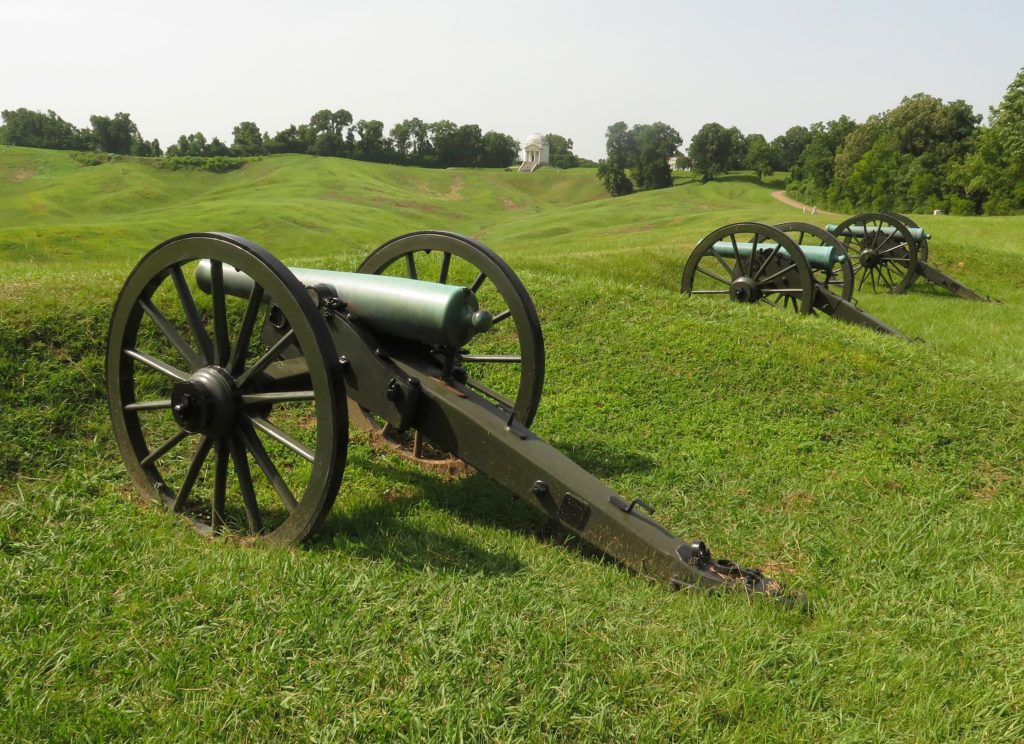
Vicksburg is where the Civil War turned. From May 18 to July 4, 1863, Ulysses S. Grant’s army laid siege to the city perched above the Mississippi, and when Vicksburg fell on Independence Day, the Union controlled the entire river and the Confederacy was cut in two. The park preserves some 1,800 acres of the battlefield with more than 1,400 monuments and markers, 20 miles of reconstructed trenches, and the recovered ironclad gunboat USS Cairo. A driving tour winds through the lines. Entry is $20 per vehicle.
117 public lands destinations are under threat. Get the free briefing that 27,000+ people use to stay informed and take action.
2. Natchez National Historical Park

Natchez was the wealthiest city in antebellum Mississippi, and its fortune was built on cotton and enslaved labor. The historical park tells that full story across three sites: the Melrose estate, a near-perfectly preserved 1840s mansion and grounds; the William Johnson House, home of a free Black businessman whose detailed diaries are a rare firsthand account of free Black life in the Deep South; and the site of Fort Rosalie, the 18th-century French fortification. Admission is free.
3. Natchez Trace Parkway
The Natchez Trace Parkway follows a corridor that people have traveled for thousands of years, from Native American footpaths to the route of 19th-century “Kaintuck” boatmen walking home from New Orleans. The modern parkway runs 444 miles from Natchez to Nashville, with no commercial traffic and a 50 mph limit that forces you to slow down. Along it sit Emerald Mound, a 35-foot ceremonial mound covering eight acres built between roughly 1200 and 1730, and stretches of the Old Sunken Trace where centuries of footsteps wore the path into a trench below the forest floor.
4. Natchez Trace National Scenic Trail

Running alongside the parkway is its quieter companion, the Natchez Trace National Scenic Trail. It is not one continuous footpath but five sections of hiking trail that let you walk the Trace the way travelers once did, on foot through hardwood forest and along the old sunken corridors. It is the slow, ground-level way to understand a route that the parkway lets you only glimpse from the car.
5. Brices Cross Roads National Battlefield Site

On June 10, 1864, Confederate cavalry under Nathan Bedford Forrest crushed a larger Union force here in one of the most lopsided tactical victories of the war. Brices Cross Roads is the only site in the country carrying the specific designation National Battlefield Site, a one-acre federal plot marking the heart of the fight, with a nearby visitor center interpreting the larger battlefield. Entry is free.
6. Tupelo National Battlefield

A month after Brices Cross Roads, on July 14 and 15, 1864, Union forces fought Forrest again at Tupelo, this time to keep him away from the railroad supplying Sherman’s march on Atlanta. They held. The battlefield is now a small monument site within the city of Tupelo, easy to pair with a drive on the nearby parkway. Entry is free.
7. Gulf Islands National Seashore

Established in 1971, Gulf Islands National Seashore stretches roughly 160 miles across Mississippi and Florida, protecting barrier islands, white-sand beaches, and coastal marshes that shelter more than 300 species of birds. On the Mississippi side, the highlight is Ship Island, reached by passenger ferry, where the brick walls of Civil War-era Fort Massachusetts stand against the Gulf. It is the closest thing the state has to a beach wilderness.

8. Medgar and Myrlie Evers Home National Monument

This modest Jackson ranch house is where civil rights leader Medgar Evers, Mississippi’s first NAACP field secretary, lived with his wife Myrlie and their children, and where he was assassinated in his own driveway in June 1963. Designated a national monument in 2020, the home is preserved much as the family left it, a quiet, devastating window into the cost of the movement and the courage of the people who carried it. Entry is free.
9. Emmett Till and Mamie Till-Mobley National Monument
Established in 2023, this is one of the most important additions to the National Park System in years. It preserves the places at the center of one of the killings that ignited the civil rights movement: in Mississippi, the Tallahatchie County Courthouse in Sumner, where an all-white jury acquitted the men who murdered 14-year-old Emmett Till in 1955, and Graball Landing, where his body was recovered from the Tallahatchie River. A third site, the Chicago church where his mother Mamie Till-Mobley insisted on an open-casket funeral so the world would see, completes the monument. It is free, and it is essential. Pair it with our guide to civil rights sites.
Planning a Mississippi National Parks Trip
When to go. Spring and fall are ideal: the Natchez Trace is at its best with redbud and dogwood in bloom or autumn color, and the heat and humidity of a Deep South summer are real. The Gulf Coast beaches are warmest May through September.
How to route it. The Natchez Trace Parkway is the spine of any Mississippi trip, linking Natchez in the southwest to Tupelo and Brices Cross Roads in the northeast, with Vicksburg a short detour west. The Evers and Till monuments anchor a civil rights route through Jackson and the Delta, and Gulf Islands caps a trip down on the coast.
Nearby states. Extend the trip with our guides to Missouri and Oklahoma national parks, or browse our national parks ranked.
More Than Just Parks is a family operation. My sons Will and Jim founded it. Their work has been featured by the National Park Service, the Department of the Interior, and outlets across the country. Mississippi taught me that a national park site does not need a mountain to leave a mark. Some of the most powerful ground in the system is here.