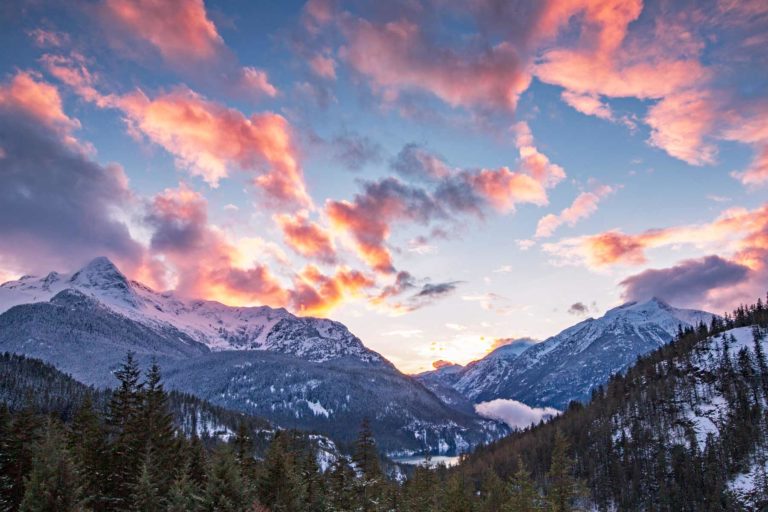


The wildest national park in the contiguous United States sits less than three hours from downtown Seattle. North Cascades National Park anchors a mountain complex that holds more than 300 glaciers, more than anywhere else in the country outside Alaska. And yet in 2025 the national park itself recorded just 46,925 visits, while the recreation area next door counted more than a million.
How does a place like that stay so empty? The answer runs through 9,600 years of human history, a failed fur trade crossing, a painter’s crusade, and a Sierra Club film. What follows are 12 verified facts about the range climbers call the American Alps. For trip planning, trails, and lodging, start with our full North Cascades National Park guide and our guide to Washington’s national parks.
Tony Pattiz taught American history for more than 25 years before he began writing it for this site. This article is built from the National Park Service’s own records, two NPS administrative histories of the park, and the primary sources listed at the end. Every date, number, and name below has been checked against them. Last verified July 2026.
North Cascades National Park Basics
- Location: Northern Washington, running up to the Canadian border, about three hours northeast of Seattle
- Size: About 505,000 acres in the national park itself; roughly 684,000 acres across the full three-unit park complex
- Highest point: Goode Mountain, 9,220 feet
- Glaciers: More than 300 across the complex, the most in the United States outside Alaska
- Visitation: 46,925 recreation visits to the national park in 2025, per NPS Stats; most of the complex’s traffic is counted in Ross Lake National Recreation Area
- Established: October 2, 1968
- Wilderness: About 93 percent of the complex is the Stephen Mather Wilderness, designated in 1988
1. No Place In The Lower 48 Holds More Glaciers
Start with the number that defines the park. According to the National Park Service, the North Cascades National Park Service Complex holds more than 300 glaciers and countless snowfields, making it the most heavily glaciated area in the United States outside of Alaska. That single complex contains roughly a third of all the glaciers in the lower 48 states.
Love North Cascades? It's one of 117 threatened public lands destinations we're tracking. Get the free briefing.
The reason is geography. These peaks stand close to the Pacific and catch its storms first, and the snow that buries the high country each winter outlasts the summer melt in hundreds of shaded basins. Where more snow falls than melts, year after year, ice forms and starts to flow.
That count needs an honest caveat. The Park Service says most of these glaciers have shrunk dramatically over the last century, and researchers who monitor them have logged year after year of ice loss, with some small glaciers disappearing outright. The 300-plus figure is the NPS number as of July 2026; the trend line points down.
2. People Have Been Crossing These Mountains For At Least 9,600 Years
Who came first to a range this rugged? Archeologists working in the park have identified 260 prehistoric sites, some dating older than 8,500 years, and recent research at Cascade Pass has documented human activity there spanning the last 9,600 years. Even the most remote corners of the park hold evidence of the people who used them.
Those studies changed how historians understand the region. The high subalpine country of the North Cascades was not empty ground between the coast and the interior; it contributed importantly to Northwest Coast Indian economies as hunting ground, berry ground, and trade route.
The historic record layered on top of it is just as rich. The park’s later archeological sites include mines and mining camps, fire lookouts, sheepherder camps, sawmills, homesteads, and one “lost” hotel.
3. Stehekin Means The Way Through The Mountains
Four Native bands primarily occupied what is now the park, according to the NPS history of the North Cascades: the Upper Skagit, the Chilliwack, the Nlaka’pamux (also called the Thompson), and the Chelan. Their boundaries overlapped, and trade moved constantly between the coast and the interior.
The main road of that trade was Cascade Pass. Skagit people kept canoes cached at the head of Lake Chelan for the trip south down the lake, and travelers worked the mountains mainly in summer and fall, when melting snow opened the high country.
Their names are still on the land. Chelan means deep water. Stehekin, the valley at the heart of the southern unit, means the way through the mountains. Thousands of years before anyone proposed a highway over the North Cascades, people already knew where the way through was.

4. A Fur Trader Made The First Recorded Crossing In 1814
The first non-Native traveler known to cross the North Cascades was Alexander Ross, a Scot who had taught school in Canada before joining John Jacob Astor’s Pacific Fur Company in 1810. Ross reached the mouth of the Columbia aboard the Tonquin in 1811 and helped establish Fort Okanogan that same year.
In 1814 he set out with three Native companions to answer a practical question: did a workable route exist between the fur posts of the interior and Puget Sound? Until then, the trip meant a long detour down the Columbia and up the coast.
I and others had contemplated for some time before, that was of penetrating across land from Ockinacken due west to the Pacific on foot.
Alexander Ross, as quoted in the NPS History Basic Data for the North Cascades
He never made it. Deep in the mountains, at a spot he named Point Turn Around, a companion refused to go on and Ross turned back. He later learned he had been only about four days’ travel from the ocean. The crossing earned him a place in the region’s history anyway; historians believe his route ran through the Stehekin Valley and over Cascade Pass, the same way through that Native traders had used for millennia.
5. The First National Park Proposal Came In 1892
North Cascades became a national park in 1968, but the idea is much older. In 1892, a group of central Washington citizens issued the first proposal to establish a national park for Lake Chelan, 76 years before Congress finally acted.
Commercial interests killed it. Local boosters led by Chelan land developer L.H. Woodin railed against the notion of a national park, arguing that free and cheap land was the region’s birthright and that Lake Chelan’s scenery should serve business as well as pleasure.
That early defeat set the pattern. For the next seven decades, nearly every park proposal for the North Cascades would run into the same wall of mining, timber, and development interests. The park that exists today was not discovered; it was fought for, proposal by proposal.
6. A Painter Earned The Title Father Of North Cascades National Park
Sometimes a painting really is worth a thousand words. Julian Itter, a Canadian-born painter of grand mountain scenes, was chosen by Washington’s delegation to run the state’s art exhibit at the 1904 St. Louis World’s Fair and to produce a series of canvases celebrating its scenery, above all Lake Chelan.
The country he painted changed him into an advocate. In 1906, Itter worked with outdoor groups and commercial clubs across Washington to pass resolutions calling for a 300-square-mile national park above the head of Lake Chelan, and he carried the proposal to Washington, D.C., pitching President Theodore Roosevelt on a park taking in Lake Chelan, Glacier Peak, and the country between Cascade Pass and the Skagit River.
He lost too. Residents of the nearby towns sided with mining interests over tourism, and Itter abandoned the campaign. But for his role as one of the first promoters of preservation in the range, he came to be called the Father of North Cascades National Park, six decades before the park existed.
7. A Sierra Club Film Helped Win The Park
The campaign that finally succeeded had a secret weapon, and it was a movie. David Brower, the Sierra Club’s first executive director from 1952 to 1969 and fresh off the fight that stopped the dams planned for Dinosaur National Monument, traveled to the Stehekin Valley in 1957 with his sons and a camera.
The result was Wilderness Alps of Stehekin, a 31-minute film that called the North Cascades a crown jewel of American scenic grandeur. Screened in town halls, living rooms, and congressional offices for the next decade, it became the single most influential piece of publicity in the struggle to protect the range.
The film did what pamphlets could not; it let people see the country at stake. On October 2, 1968, President Lyndon B. Johnson signed the North Cascades Act, and the park Itter had imagined in 1906 finally existed. A camera helped build this park.
8. It Is Really Three Parks Managed As One
The 1968 act created more than a national park. North Cascades National Park, Ross Lake National Recreation Area, and Lake Chelan National Recreation Area are together managed as the North Cascades National Park Service Complex, roughly 684,000 acres in all.
The national park itself, about 505,000 acres split into a north and a south unit, is the wild core. Ross Lake National Recreation Area, about 118,000 acres, wraps the State Route 20 corridor and its chain of hydroelectric reservoirs. Lake Chelan National Recreation Area, about 62,000 acres, holds the Stehekin Valley at the head of Lake Chelan, still reachable only by boat, floatplane, or trail.
Congress went one step further in 1988, designating about 93 percent of the whole complex as the Stephen Mather Wilderness. No highway crosses the national park itself; the only road that reaches inside it is the rough gravel end of Cascade River Road, which dead-ends at the Cascade Pass Trailhead. That fact explains almost everything about the next one.

9. The National Park Itself Is One Of The Least Visited In America
In 2025, North Cascades National Park recorded 46,925 recreation visits, per NPS Stats. Yet that same year, Ross Lake National Recreation Area next door counted 1,173,028 visits.
Those two numbers are the key to the whole place. Nearly a million people drive State Route 20 through the complex, stop at Diablo Lake, and go home believing they have visited North Cascades National Park. Statistically, they have not; the highway and its overlooks sit inside the recreation area, and the park’s counting stations sit on the trails beyond it. With that one gravel dead end excepted, reaching the national park proper means walking in. We put the park on our list of the least visited national parks for exactly this reason.
One planning note: State Route 20, the only road through the complex, closes every winter and its opening dates swing widely from year to year. It is typically closed from late November to early May. Check the WSDOT North Cascades Highway page and the park’s road conditions page before you go.

10. Goode Mountain Tops The Park At 9,220 Feet
The park’s roof is Goode Mountain, 9,220 feet, the tallest peak inside the park boundary and one of the tallest non-volcanic summits in Washington. It carries the name of Richard Urquhart Goode, a topographer with the United States Geological Survey. Its neighbors are giants too, including Buckner Mountain at 9,114 feet and Mount Logan at 9,087.
What the numbers hide is the relief. These peaks rise from valley floors that sit only a few hundred feet above sea level, so the vertical walls here rival ranges twice their height on paper. That is why generations of mountaineers have called the North Cascades the American Alps, and why the park holds some of the finest alpine climbing on the continent, from Mount Shuksan to the Boston Basin cirque. The Park Service maintains route information on its planning a climb page.

11. No National Park Has Recorded More Plant Species
Here is a superlative most visitors never guess. According to the National Park Service, no other US national park surpasses North Cascades in the number of plant species recorded, with about 1,630 vascular plant species identified across the park’s eight life zones.
The variety comes from extremes packed close together. The west slope wrings rain and snow out of Pacific storms and grows moss-draped forest; the east slope sits in the rain shadow and dries into open pine country; and in between, elevation climbs from river bottom to glacier in a handful of miles. Each combination of rock, soil, slope, and rainfall makes another habitat, and something has learned to grow in nearly all of them.
12. Grizzly Bears Are Officially Coming Back
The North Cascades shelter 75 mammal species in 21 families, including wolverines, cougars, and Canada lynx, and three of those species, the gray wolf, the grizzly bear, and the lynx, are federally listed as threatened or endangered. For decades, though, the grizzly was a resident in name only, with no confirmed population on the US side of the range.
That is now changing by design. In April 2024, the National Park Service and the US Fish and Wildlife Service signed a joint decision to actively restore grizzly bears to the North Cascades ecosystem. The plan calls for moving three to seven bears a year, for five to ten years, from the Rocky Mountains or interior British Columbia until an initial population of about 25 is established, with a long-term goal of roughly 200 bears over the next 60 to 100 years.
A century from now, the wildest park in the lower 48 may have its biggest resident back.
Do You Need A Reservation For North Cascades National Park?
No. There is no reservation system to enter the park and no entrance fee, so folks can come and go at any hour. Campgrounds are the exception. From mid-May to early September every campground needs a reservation, booked on Recreation.gov.
How To See This Country Yourself
The classic first look is the Diablo Lake Overlook on State Route 20, where the lake glows an improbable glacier-fed turquoise. The easiest walk to a big view is the Sterling Munro Boardwalk behind the North Cascades Visitor Center in Newhalem, a few hundred feet of boardwalk ending at a straight shot of the Picket Range. To stand in the park’s history, hike the trail toward Cascade Pass, the same crossing Native traders used for thousands of years and Alexander Ross likely followed in 1814.
For the full rundown of overlooks, walks, and the boat up Lake Chelan to Stehekin, start with our guide to the best things to do in North Cascades National Park.

Where These Facts Come From
Every claim in this article was checked against the sources below in July 2026. Numbers that change over time, like glacier counts and annual visitation, are stated with the year they were reported.
- NPS, Glaciers / Glacial Features, for the glacier count, the most-glaciated superlative, and glacier shrinkage
- NPS, History and Culture of North Cascades, for the 260 prehistoric sites, the 8,500-year dates, and the 9,600 years of activity at Cascade Pass
- NPS History Basic Data, The Indians, for the four bands, the Cascade Pass trade route, cached canoes, and the meanings of Chelan and Stehekin
- NPS History Basic Data, Fur Trading and Trapping, for Alexander Ross’s career and his 1814 crossing
- NPS administrative history, Contested Terrain, for the 1892 Lake Chelan park proposal and L.H. Woodin’s opposition
- Spokane Historical, Julian Edward Itter, for Itter’s 1904 World’s Fair exhibit, his 1906 park campaign, and his Father of North Cascades National Park title
- Sierra Club, David Brower, and the North Cascades Conservation Council, for Brower’s tenure and the 1957 film Wilderness Alps of Stehekin
- HistoryLink, for President Johnson signing the North Cascades Act on October 2, 1968
- NPS, North Cascades Management, and Washington Wild, Stephen Mather Wilderness, for the three-unit complex and the 1988 wilderness designation
- NPS Stats (IRMA) and Smithsonian Magazine, for 2024 and 2025 recreation visits to the park and to Ross Lake National Recreation Area
- NPS, Plants of North Cascades and NPS, Mammals of North Cascades, for the plant and mammal species counts
- NPS news release, April 2024, for the grizzly bear restoration decision
Keep Exploring The North Cascades
- North Cascades National Park Guide, our full trip planning hub
- Best Hikes In North Cascades National Park, from boardwalks to Cascade Pass
- Washington’s National Parks, all three, ranked and planned
- Mount Rainier National Park Facts, more Washington mountain history
- Olympic National Park Facts, the state’s wild west side
- Before you go, check live alerts and air quality on our national park conditions dashboard
What to Bring to North Cascades
Gear we recommend for North Cascades. Affiliate links support our work at no cost to you.
More Than Just Parks may earn a small commission from purchases made through these links, at no extra cost to you. We only recommend gear we would actually use.
Affiliate disclosure: Some links on this page earn us a small commission at no extra cost to you. We only recommend gear we actually use.