


More American history runs through Virginia than almost anywhere else. The Old Dominion gave the country its first lasting English colony, the homes of four of its first five presidents, and the battlefields where the Civil War began and ended.
I taught this history for a career before joining my sons to film these places, and Virginia is where I send anyone who wants to understand how the nation was made and unmade. The 20 landmarks below run from a glittering cave to the military park where the war’s final campaign played out.
Here is our ranked list of the best landmarks and historic sites in Virginia, counting down to number one.
Virginia Landmarks At A Glance
A quick guide for planning. The colonial sites cluster on the Peninsula near Williamsburg; the presidential homes and battlefields spread across the Piedmont; Shenandoah anchors the mountains.
117 public lands destinations are under threat. Get the free briefing that 27,000+ people use to stay informed and take action.
| Landmark | Type | Location |
|---|---|---|
| Fredericksburg & Spotsylvania | Civil War park | Fredericksburg |
| Colonial Williamsburg | Living history | Williamsburg |
| Arlington National Cemetery | National cemetery | Arlington |
| Mount Vernon | Historic estate | Mount Vernon |
| Shenandoah National Park | National park | Luray |
| Manassas Battlefield | Civil War park | Manassas |
| Booker T. Washington Natl Mon | Historic site | Hardy |
| Harpers Ferry NHP | Historical park | Harpers Ferry (WV) |
| Petersburg Battlefield | Civil War park | Petersburg |
| Appomattox Court House | Civil War site | Appomattox |
| Monticello | Historic estate | Charlottesville |
| Fort Monroe Natl Monument | Historic fort | Hampton |
| Richmond Battlefield Park | Civil War park | Richmond |
| George Washington Birthplace | National monument | Colonial Beach |
| Virginia Museum of Fine Arts | Art museum | Richmond |
| Edgar Allan Poe Museum | Literary museum | Richmond |
| Jamestown Settlement | Colonial site | Williamsburg |
| Blue Ridge Mountains | Mountain range | Western Virginia |
| Chrysler Museum of Art | Art museum | Norfolk |
| Luray Caverns | Cave | Luray |
20. Luray Caverns
The largest caverns in the eastern United States, discovered in 1878 beneath the Shenandoah Valley. Columns and draperies of stone fill chambers the size of cathedrals.
Its Great Stalacpipe Organ plays music by tapping the formations, the world’s largest musical instrument of its kind.
19. Chrysler Museum of Art
This Norfolk museum holds more than 30,000 works across 50 galleries, with a glass collection among the finest in the country.
Its working glass studio offers live demonstrations, and admission is free.
18. Blue Ridge Mountains
Part of the ancient Appalachians, the Blue Ridge are among the oldest mountains on earth, worn soft over hundreds of millions of years.
The Blue Ridge Parkway and Skyline Drive trace their crests, with overlooks that give the range its smoky blue haze.
17. Jamestown Settlement
Founded in 1607, Jamestown was the first permanent English settlement in North America. It is also where the first enslaved Africans were brought to the English colonies in 1619.
The living-history museum recreates the fort, a Powhatan village, and replicas of the three ships that crossed the Atlantic.
16. Edgar Allan Poe Museum
Set in Richmond’s oldest standing house, this museum honors Poe, who grew up in the city and launched his career here.
It holds manuscripts, letters, and personal belongings of the writer who shaped American horror and detective fiction.
15. Virginia Museum of Fine Arts
One of the largest art museums in the country, the VMFA in Richmond spans ancient to contemporary work across global cultures.
Its Fabergé collection is the largest outside Russia. General admission is free.
14. George Washington Birthplace National Monument
On Popes Creek near the Potomac, this monument marks where Washington was born in 1732 and spent his early childhood.
The National Park Service keeps a memorial house and a working colonial farm on the quiet tidewater grounds.
13. Richmond National Battlefield Park
As the Confederate capital, Richmond was a Union target for nearly the whole war. This park preserves the battlefields and forts that ringed the city.
Start at the Tredegar Iron Works visitor center on the James River for the fullest account.
12. Fort Monroe National Monument
The largest stone fort ever built in the country, Fort Monroe guards Hampton Roads. Nearby Point Comfort is where enslaved Africans first landed in English America in 1619.
In 1861 enslaved people who reached the Union-held fort were declared contraband and not returned, an early crack in slavery. That double history gives the site its name, Freedom’s Fortress.
11. Monticello
Thomas Jefferson designed and built this mountaintop home near Charlottesville, the only house in the country on the UNESCO World Heritage list.
It was also a working plantation where more than 600 people were enslaved over Jefferson’s lifetime. The tours now tell their stories alongside his, including the Hemings family.
10. Appomattox Court House
On April 9, 1865, Robert E. Lee surrendered the Army of Northern Virginia to Ulysses S. Grant in the McLean House here, effectively ending the Civil War.
The National Park Service has restored the village to look as it did that day.
9. Petersburg National Battlefield
The siege of Petersburg ran nine and a half months, the longest of the war, as Grant cut the supply lines feeding Lee’s army and Richmond.
The park preserves the trenches and the Crater, where a Union mine blew a gap in the Confederate line in 1864.
8. Harpers Ferry National Historical Park
At the confluence of the Potomac and Shenandoah rivers, the town of Harpers Ferry lies in West Virginia, with the park’s Loudoun Heights reaching into Virginia.
John Brown’s 1859 raid on the federal armory here helped light the fuse of the Civil War. The restored lower town is preserved by the Park Service.
7. Booker T. Washington National Monument
This monument near Hardy preserves the tobacco farm where Booker T. Washington was born into slavery in 1856.
He went on to found the Tuskegee Institute and become the most prominent Black educator of his era. The site interprets enslaved life on the farm where he began.
6. Manassas National Battlefield
Manassas, also called Bull Run, was the site of the first major land battle of the Civil War in July 1861, and a second clash in 1862.
The first battle shattered the hope of a short war. The rolling fields and Henry Hill are preserved by the Park Service.
5. Shenandoah National Park
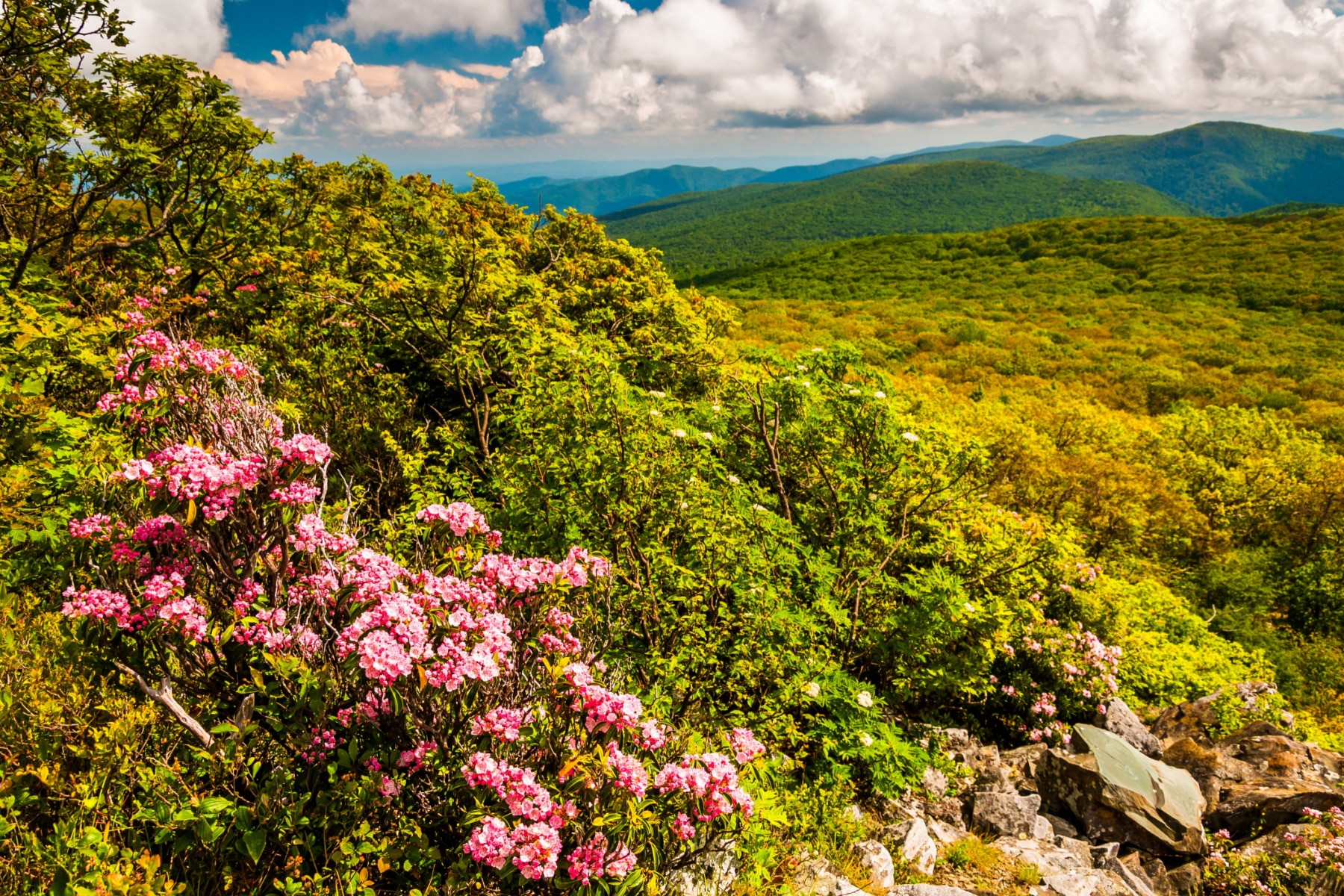
Just 75 miles from Washington, Shenandoah strings together waterfalls, overlooks, and more than 500 miles of trail along the Blue Ridge.
Skyline Drive runs its 105-mile spine. In fall the ridges turn to fire, and black bears are a common sight.
4. Mount Vernon
George Washington’s estate above the Potomac is the most visited historic home in the country, kept much as he left it.
It was also a plantation worked by more than 300 enslaved people, and the grounds now honor them with a memorial and dedicated tours.
3. Arlington National Cemetery
More than 400,000 service members, veterans, and their families rest on these hills above the Potomac, on land once part of a Lee family estate.
The Tomb of the Unknown Soldier, guarded around the clock, and the Kennedy gravesite are the most visited points. The Changing of the Guard is a quiet, exacting ceremony.
2. Colonial Williamsburg
Virginia’s colonial capital from 1699 to 1780, Williamsburg is now the largest living-history museum in the country, its streets worked by costumed tradespeople.
Walk the Governor’s Palace, the Capitol, and the shops, where the debates that led to independence once played out.
1. Fredericksburg & Spotsylvania National Military Park
Our number one is four battlefields in one park: Fredericksburg, Chancellorsville, the Wilderness, and Spotsylvania Court House. More men fell on this ground than almost anywhere in North America.
It was here Stonewall Jackson was mortally wounded by his own men. The park ties together the war’s hardest fighting in a single drive.
Plan a full day. Start at the Fredericksburg visitor center, then follow the auto tour through Chancellorsville and the Wilderness to Spotsylvania.
More Things To Do
With the landmarks covered, Virginia keeps offering. A few more ways to fill the trip:
- Drive Skyline Drive or the Blue Ridge Parkway for the mountain overlooks.
- Tour the presidential homes of Madison and Monroe near Charlottesville.
- Eat your way along the Chesapeake for oysters and Brunswick stew.
- See Virginia’s national park sites for more protected history and land.
You should know that this guide does not come out of thin air. My sons Will and Jim have spent their adult lives exploring America’s national parks and public lands destinations.
Will and Jim have worked with the National Park Service, the Department of the Interior, the USDA, and the U.S. Forest Service creating films on the places and issues that matter. In 2018, after a career teaching history, I joined them to help tell the stories behind these sites.


