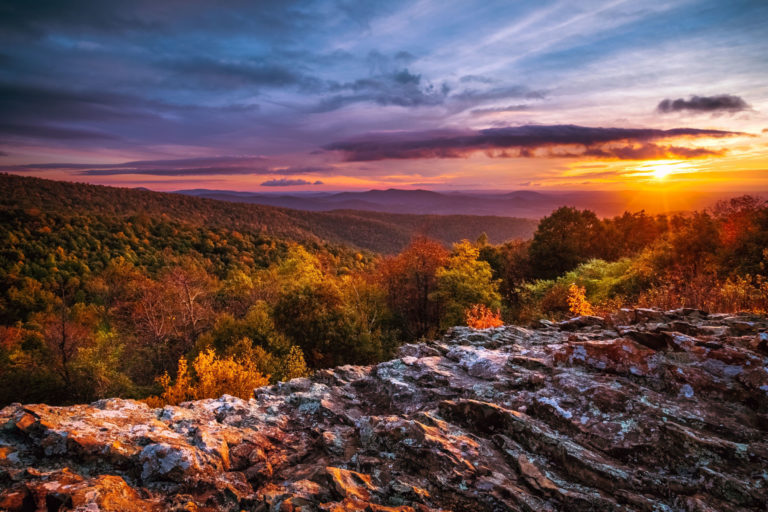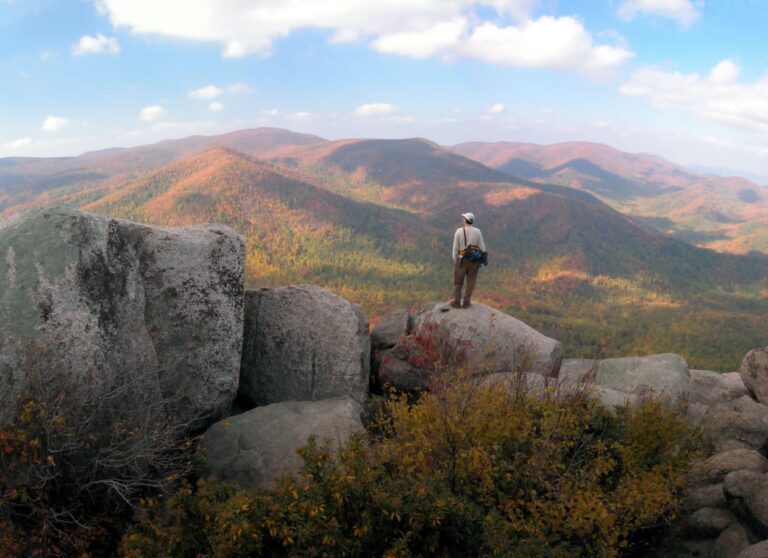


Shenandoah National Park covers 198,754 acres of the Blue Ridge Mountains in northern Virginia. It is known for Skyline Drive, the 105-mile road along the crest with 70 overlooks, and for 516 miles of hiking trails, 101 of them on the Appalachian Trail. Nearly 80,000 acres are designated wilderness.
Shenandoah National Park was not carved out of a wilderness nobody owned. It was pieced together from more than 3,000 individual tracts of farms, orchards, and mountain land, purchased or condemned by the Commonwealth of Virginia and handed to the federal government, and at least 500 families lost their homes in the process. That is a harder origin story than most parks carry, and it happened about 75 miles from Washington, D.C.
What follows are 12 verified facts about Shenandoah, from granite more than a billion years old to the segregated campground that integrated ahead of the rest of Virginia. For trails, overlooks, and trip planning, start with our full Shenandoah National Park guide.
Tony Pattiz taught American history for more than 25 years before he began writing it for this site, and Shenandoah’s story, the New Deal, the CCC, and the families the park displaced, sits squarely in the period he taught. Every date, number, and name in this article has been checked against the National Park Service and the primary sources listed at the end. Last verified July 2026.
Love Shenandoah? It's one of 117 threatened public lands destinations we're tracking. Get the free briefing.
Shenandoah National Park Basics
- Location: The crest of the Blue Ridge Mountains in northern Virginia, about 75 miles from Washington, D.C.
- Size: 198,754 acres, including 79,579 acres of designated wilderness, per the NPS park statistics
- Visitation: 1,682,152 recreation visits in 2025, per NPS Stats
- Highest point: Hawksbill, at 4,051 feet
- Roads and trails: 105 miles of Skyline Drive and 516 miles of hiking trails, including 101 miles of the Appalachian Trail
- Established: Authorized May 22, 1926; established December 26, 1935; dedicated by President Franklin D. Roosevelt on July 3, 1936
1. The Oldest Rocks In The Park Are More Than A Billion Years Old
Start with the deepest history there is. The basement rocks under Shenandoah formed between 1.2 and 1.0 billion years ago, when colliding plates raised the ancient Grenville mountain range. That is roughly a quarter of the age of the Earth, and hundreds of millions of years before the supercontinent Pangea ever existed.
Two of those ancient rock units give the park its most famous scenery. The Old Rag Granite, about 1.1 billion years old, is the light colored, coarse crystaled rock that hikers scramble over on Old Rag Mountain. The Pedlar Formation, a banded gneiss, shows its stripes in outcrops along Skyline Drive. Every overlook on the drive is a view from the worn down stump of a mountain range that once stood far higher than today’s Blue Ridge.

2. People Have Lived In These Mountains For At Least 9,000 Years
Who walked these ridgelines first? According to the National Park Service, people have lived in the Blue Ridge Mountains for at least 9,000 years. American Indians hunted and gathered game, fruit, nuts, and berries on the upland slopes, moving with the seasons rather than settling the high ground permanently.
The pattern matters. For thousands of years the mountains were a working commons, a place people came up to for hunting and gathering rather than settled year round. When European settlers later pushed into the hollows, they were joining a human story on this ridge that was already ancient.
3. A German Physician Was The First European On Record To Crest The Blue Ridge
In March 1669, a German born physician named John Lederer and his small party became the first Europeans on record to crest the Blue Ridge. Lederer made three expeditions into these mountains in 1669 and 1670, mapping landforms that no colonist had described before.
He wrote it all down. His reports, translated from Latin and published in 1672 as The Discoveries of John Lederer, gave English readers their first real account of the Virginia interior. If, as geographers have suggested, he followed the Rapidan River toward its headwaters, his route to the crest would have run through what is now the central district of Shenandoah National Park.
4. A Resort Showman Planted The Seed Of The Park At Skyland
Decades before there was a park, there was a resort. In the late 1800s, a Washington, D.C. promoter named George Freeman Pollock developed Stony Man Camp, later called Skyland, high on the Blue Ridge. He ran it with a showman’s flair. His ever present bugle woke guests each morning, called them to meals and elaborate entertainments, and announced the departure of the daily mail. Over the years he sold and developed cabins on almost fifty lots, establishing the rustic architecture still visible at Skyland today.
Pollock wanted more than a resort. By 1924 he and his allies in the Northern Virginia Park Association were campaigning for a national park along the Blue Ridge with Skyland at its center. Congress responded on February 21, 1925, with $20,000 to survey proposed parks in the southern Appalachians, and authorized a Shenandoah park of 521,000 acres, soon reduced to 400,000. The catch was enormous. Virginia had to buy the land and donate it to the federal government.
5. Virginia Condemned The Land And Handed It To The Nation
How does a state buy a national park? When Harry Byrd became governor in 1926, he put a businessman named William E. Carson in charge of Virginia’s new Commission on Conservation and Development and gave him the job of acquiring an estimated 4,000 properties inside the proposed boundary. A public campaign set out to raise $2,500,000 for the purchases, but pledges and prices never lined up, and Carson pushed to shrink the park to something the state could actually afford.
The decisive tool was Virginia’s blanket condemnation law, the Public Park Condemnation Act of 1928, which let the state condemn the land proposed for the park in blanket proceedings rather than thousands of separate lawsuits. Legal challenges ran all the way to the end of 1935, when the land was finally cleared and deeded to the United States. Shenandoah was established that December, and President Roosevelt dedicated it at Big Meadows on July 3, 1936.
6. At Least 500 Families Were Displaced To Create The Park
This is the fact the overlooks do not show. When Virginia condemned the mountain, people were living on it, in hollows their families had farmed for generations. The National Park Service records that at least 500 families were displaced from their homes as the park came together in the 1930s.
They were badly served by the press of their day. A 1933 study called Hollow Folk, by Mandel Sherman and Thomas Henry, painted the residents as isolated primitives in mud plastered log cabins, out of reach of law, government, and modern life. Archaeology tells a different story. Excavations of the old homesites show families who owned varied property, ran businesses, and bought the same consumer goods as other rural Americans of the era. The caricature made the removals easier to accept, and CCC crews later erased most of the physical evidence of the settlements. Remembering those families accurately is part of the park’s job now, and part of ours.
7. A President Built His Getaway Inside The Future Park
Before Camp David, there was Rapidan Camp. President Herbert Hoover and First Lady Lou Henry Hoover established the rustic retreat at the headwaters of the Rapidan River during his administration, from 1929 to 1933, and escaped there to fish for trout and to hold quiet meetings through the opening years of the Great Depression. Their cabin was known as the Brown House, a mountain counterpart to the White House.
When Hoover left office, the camp was given over for the use of future presidents and folded into the new national park. Three original buildings still stand, including the Brown House and the Prime Minister’s Cabin, and the site was designated a National Historic Landmark in 1988 under its old name, Camp Hoover. Rangers lead seasonal tours from the Byrd Visitor Center, and hikers can reach the camp on trails from Skyline Drive.
8. The First CCC Camps In Any National Park Opened Here In 1933
In the depths of the Depression, President Franklin D. Roosevelt asked Congress for a new kind of workforce, and he was specific about what he wanted.
I propose to create a civilian conservation corps to be used in simple work, not interfering with normal employment, and confining itself to forestry, the prevention of soil erosion, flood control and similar projects.
Franklin D. Roosevelt, message to Congress, March 21, 1933
Shenandoah answered first. The first two Civilian Conservation Corps camps located in any national park were established here in May 1933, at Skyland and Big Meadows. Between May 1933 and March 1942, 12 CCC camps in 9 locations operated in and around the park, housing more than 1,000 young men at a time and more than 6,500 over the life of the program. Roosevelt himself visited Camp Nira in the park in August 1933, five months after taking office.
The CCC boys built much of what visitors still touch today, overlook walls, picnic grounds, comfort stations, trails, and fire roads, and by the Park Service’s own count they planted 147,595 trees and shrubs. The old claim that the CCC built the park is an overstatement, paid contractors built the road itself, but the park’s public face is largely their handiwork.

9. Skyline Drive Took Most Of A Decade To Build
The park’s signature road was built in pieces, mostly before the park itself officially existed. Ground was broken on July 18, 1931, using emergency employment relief funds. The central section, 34 miles between Thornton Gap and Swift Run Gap, opened to the public on September 15, 1934. The northern 32 miles to Front Royal followed on October 1, 1936, and the southern stretch was completed in August 1939. CCC crews graded the slopes, built the stone guard walls, and shaped the sweeping overlooks that make the drive feel inevitable.
The finished road runs 105 miles along the crest of the Blue Ridge, the only public road through the park, with some 70 overlooks along the way. The Park Service suggests allowing 3 to 4 hours to drive it end to end, and the speed limit is not the only reason to go slow. Deer, black bears, and wild turkeys cross the pavement daily. In 2008 Skyline Drive was designated a National Historic Landmark for its place in the development of the eastern national parks.
10. Lewis Mountain Was Built As A Segregated Campground
Shenandoah opened in the Jim Crow South, and the park carried that burden from the start. Under pressure from Virginia interests, and against the protests of Interior Secretary Harold L. Ickes, the park’s facilities were segregated, and Lewis Mountain was set aside in the park’s plans as a separate development for Black visitors. Portions of it opened in the summer of 1939, with the first cabins and a lodge in service by the summer of 1940.
The wall came down in stages. In October 1947, a new concession manager integrated Lewis Mountain and the main dining room at Panorama. By the summer of 1950 the park’s facilities were fully integrated, more than a decade before similar results elsewhere in the Commonwealth. Lewis Mountain is still a working campground today, and its story is now told openly as part of the park’s history rather than left off the map.
11. More Than 1,400 Plant Species Grow In The Park
For a park assembled from land that had been lived on, farmed, and grazed for generations, Shenandoah’s forests are astonishingly rich. Over 1,400 species of vascular plants grow here, per the NPS plant inventory, and fewer than 100 of them are the trees and shrubs most visitors notice. The rest is the understory, trillium and jack in the pulpit, azaleas and blueberries, ferns and lady slipper orchids.
The variety comes from the terrain. The park’s 70 mile length and 3,500 foot elevation range create habitat for many forest types, oak and hickory across most slopes, tulip poplar and cove hardwoods in the sheltered stream valleys, and small pockets of spruce and fir holding out on the coolest, highest ground.
12. The Park Is Now A Refuge For Wildlife The Region Once Lost
The Blue Ridge lost its biggest animals early. Hunting eliminated bison from the region around 1798 and elk in 1855, according to the NPS wildlife records, decades before anyone imagined a park here. What the park protects today is a recovery. Over 190 resident and transient bird species, over 50 mammal species, over 20 reptile and amphibian species, and over 40 fish species now live within its boundaries.
Some of them are easy to meet. White tailed deer graze the shoulders of Skyline Drive in broad daylight. Others take patience, black bears and bobcats keeping mostly to the deep forest, skunks and bats moving at dusk, and the shrews and voles that spend their whole lives under the leaf litter.
How To See This History Yourself
Here is how to stand inside these facts on your own visit. The exhibits at the Harry F. Byrd Sr. Visitor Center at Big Meadows walk through the park’s founding, the displaced families, and the CCC years, and in season rangers lead tours down to Rapidan Camp and the Brown House itself. The CCC’s stonework is under your hands at nearly every overlook wall on Skyline Drive, and a night at Lewis Mountain puts you inside one of the most important civil rights stories in the park system.
For the full trip plan, from Old Rag permits to the best waterfall hikes, see our guide to the best things to do in Shenandoah National Park.
Where These Facts Come From
Every claim in this article was checked against the sources below in July 2026. Numbers that change over time, like annual visitation, are stated with the year they were reported.
- NPS, Shenandoah Park Statistics, for acreage, wilderness, trail miles, Hawksbill’s elevation, and the establishment dates
- NPS Stats (IRMA), for 2025 recreation visits
- NPS, Shenandoah Frequently Asked Questions, for Skyline Drive’s length, driving time, and the Appalachian Trail mileage
- NPS, Shenandoah Geologic Formations, and USGS, Geology of Shenandoah National Park, for the Grenville basement rocks, the Old Rag Granite, and the Pedlar Formation
- NPS, People of Shenandoah, for 9,000 years of human history in the Blue Ridge
- Encyclopedia Virginia, Shenandoah National Park, for John Lederer’s expeditions and Virginia’s condemnation of the parkland
- NPS, Skyland, for George Freeman Pollock and Stony Man Camp
- NPS, Shenandoah National Park From Idea to Reality, for the park association, the 1925 legislation, Byrd, Carson, and the land acquisition
- Christine Homa, “Shenandoah National Park: The Human Cost of Conservation,” DttP, American Library Association, for the Public Park Condemnation Act of 1928 and the Via lawsuit
- NPS, The Displaced, for the displaced families, the 3,000 tracts, and the Hollow Folk study
- NPS, Rapidan Camp, for the Hoover retreat and its National Historic Landmark status
- NPS, Civilian Conservation Corps at Shenandoah, and NPS, Shenandoah Not Without the CCC, for the camps, the enrollees, and the FDR visit
- The American Presidency Project, FDR Message to Congress, March 21, 1933, for the CCC quotation
- NPS, The Greatest Single Feature, and the Virginia Department of Historic Resources, for Skyline Drive’s construction dates and landmark designation
- NPS, Segregation and Desegregation at Shenandoah, for Lewis Mountain and the park’s integration
- NPS, Shenandoah Plants and NPS, Shenandoah Animals, for the species counts
Keep Exploring Shenandoah
- Shenandoah National Park Guide, our full trip planning hub, including current fees and reservation rules
- Best Things To Do In Shenandoah National Park
- Virginia National Parks Worth Visiting
- Historic Sites In Virginia, more of the state’s layered past
- Great Smoky Mountains National Park Facts, the other great Appalachian park story
- All 63 US National Parks Ranked
- Before you go, check live alerts and air quality on our national park conditions dashboard
What to Bring to Shenandoah
Gear we recommend for Shenandoah. Affiliate links support our work at no cost to you.
More Than Just Parks may earn a small commission from purchases made through these links, at no extra cost to you. We only recommend gear we would actually use.
Affiliate disclosure: Some links on this page earn us a small commission at no extra cost to you. We only recommend gear we actually use.