

The National Park Service counts 22 official park units in Virginia, one of the better hauls in the country, and exactly one of them is a full national park. That’s Shenandoah, and if you’re only doing one thing from this article, that’s the thing.
The rest of Virginia’s park sites are mostly history, and we mean that as a compliment. Four of America’s first five presidents came from Virginia, the English colonies started here, the Civil War practically lived here, and the park system reflects all of it. Some of these sites are excellent. Some are a plaque and a parking lot. We’ll tell you which is which.
This guide covers 31 sites, ranked honestly, with 2026 fees and the practical details. A word on the math, because 22 and 31 don’t obviously add up. The official unit count is 22, but the NPS Virginia list also names sub-sites like Great Falls and Cape Henry, shared long-distance trails, and partnership areas, and that’s where the extra slots come from.
One more bookkeeping note. The NPS list counts Historic Jamestowne and Yorktown separately, but they’re both parts of Colonial National Historical Park, so we cover them together and give the freed-up slot to Wolf Trap, which earlier versions of this article inexplicably forgot existed.
117 public lands destinations are under threat. Get the free briefing that 27,000+ people use to stay informed and take action.

Virginia’s Top Park Sites at a Glance
| Site | Type | The Draw | 2026 Fee | Time Needed |
|---|---|---|---|---|
| Shenandoah | National Park | Skyline Drive, Old Rag, 500 miles of trails | $30/vehicle | 1-3 days |
| Blue Ridge Parkway | Parkway | 217 Virginia miles of ridgeline driving | Free | 1-2 days |
| Assateague Island | National Seashore | Wild ponies on a wild beach | $10/vehicle (VA side) | 1 day |
| Appalachian Trail | Scenic Trail | More AT miles than any other state | Free | An hour to a month |
| Colonial NHP | Historical Park | Jamestown and Yorktown, the bookends of colonial America | $15/adult | 1 day |
| Appomattox Court House | Historical Park | The room where the Civil War ended | Free | Half day |
| Fort Monroe | National Monument | Freedom’s Fortress, 1619 to the Civil War | Free | Half day |
| Manassas | Battlefield Park | First and Second Bull Run | Free | Half day |
| Harpers Ferry | Historical Park | John Brown’s raid at the rivers’ confluence | $20/vehicle | Half to full day |
| Great Falls Park | Park | The Potomac going berserk 15 miles from DC | $20/vehicle | 2-4 hours |
The Headliners
1. Shenandoah National Park
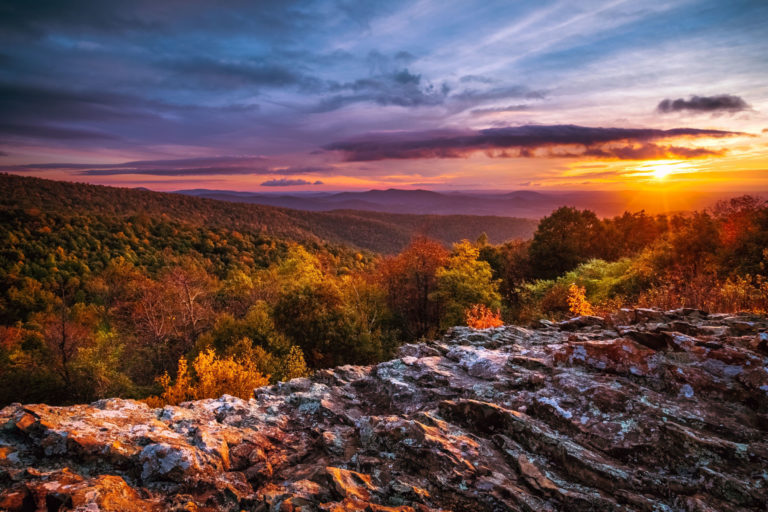
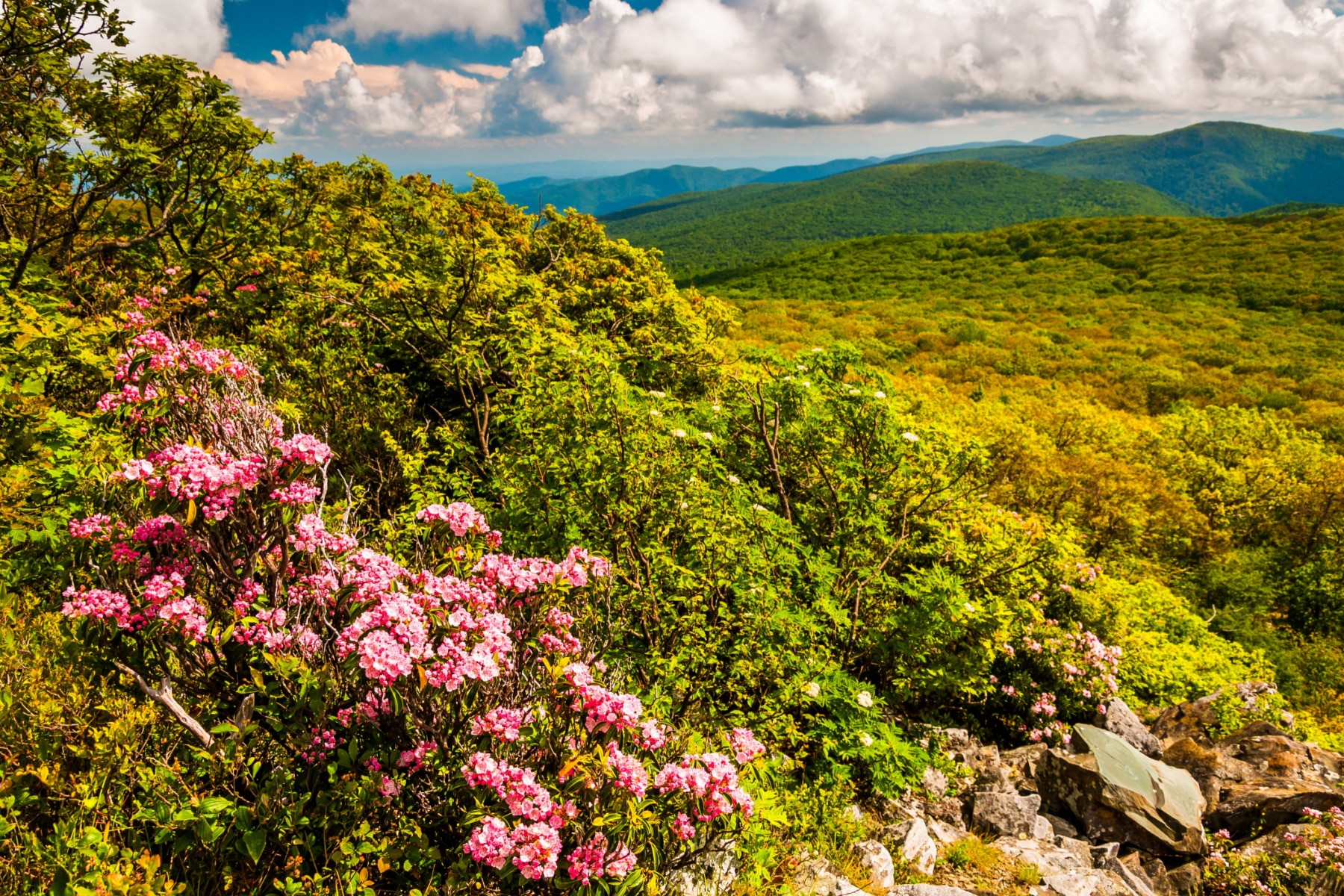
A long green ribbon down the crest of the Blue Ridge, 75 miles from Washington and a world away from it. Shenandoah drew 1,682,152 visits in 2025 and still hides quiet hollows on a fall Saturday if you’re willing to walk ten minutes from an overlook, which statistically nobody is.
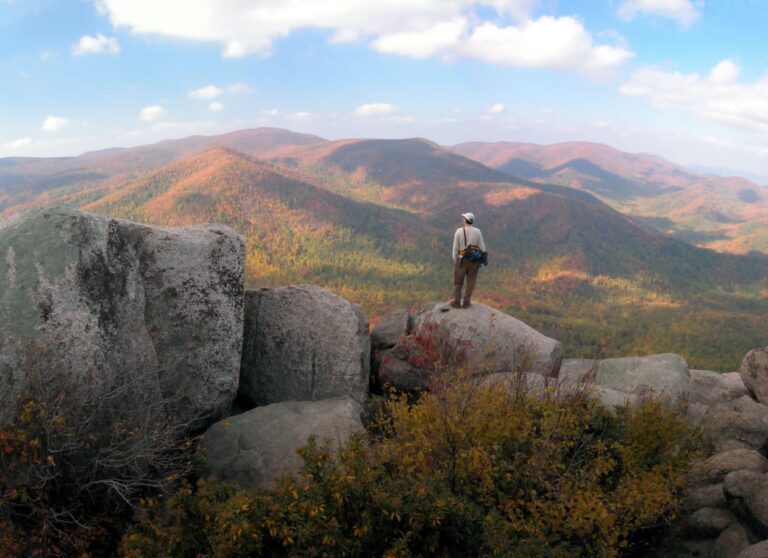
Skyline Drive runs all 105 miles of the park with 70-some overlooks, and it’s lovely, but the park is the trails. There are over 500 miles of them, including 101 miles of the Appalachian Trail. Our picks are in our guide to the best hikes in Shenandoah, and the short answer is Old Rag, the best rock scramble in the eastern United States.
Old Rag now requires a day-use ticket from March 1 through November 30. It’s $2 on Recreation.gov on top of the entrance fee, 800 tickets a day, released 30 days and 5 days out. Mildly annoying, demonstrably better than the pre-ticket conga line up the summit ridge.
Shenandoah is also the rare eastern park you can properly sleep inside. Skyland (mile 41.7) and Big Meadows Lodge (mile 51) are the two lodges, both run by concessioner Delaware North, and a sunset dinner at Skyland is worth planning a day around. Campers get five seasonal campgrounds; Big Meadows is the popular one and reservation-only on Recreation.gov, so book the day your window opens. If you want a waterfall, Dark Hollow Falls at mile 50.7 is the classic, 1.4 miles round trip to a 70-foot cascade with 440 feet of climbing back out, the shortest falls walk in the park. And the black bears are not a rumor. Shenandoah has one of the densest populations in the country, so a bear ambling across Skyline Drive is routine, not luck.
Access notes. $30 per vehicle for 7 days. Four entrances (Front Royal, Thornton Gap, Swift Run Gap, Rockfish Gap); fall color season is spectacular and traffic-jammed, so go midweek in October or accept your fate. Full activity list in our things to do in Shenandoah guide, plus some lesser-known Shenandoah facts.
2. Blue Ridge Parkway

America’s favorite drive picks up where Skyline Drive ends at Rockfish Gap and runs 469 miles to the Smokies, 217 of them in Virginia. It is consistently among the most visited units in the entire park system, and the Virginia stretch is the quieter, less developed half, which we consider a feature.
The question folks always ask. Skyline Drive or the Blue Ridge Parkway? Same crest, same unhurried pace, different deals. Skyline Drive is gated, costs $30, and concentrates 70 overlooks, two lodges, and the park’s best trailheads into 105 miles; the parkway is free, gateless, quieter, and stingier with services. Our call is simple. For one big October day, pay for Skyline and go midweek, because it jams first and worst when the color peaks. If gates and fees annoy you, or you’re headed south anyway, the parkway gives you more ridge for zero dollars.
The Virginia highlights, in order of appearance heading south. Humpback Rocks (steep mile to the best sunrise ledge in the state), the Peaks of Otter, and Mabry Mill around milepost 176, the most photographed building on the entire parkway. Rule of thumb for planning. The parkway averages 30-something mph in practice, so 100 miles is a full afternoon, not an errand.
Access notes. Free, no gates, open year-round except when ice closes sections. Fuel up before you get on; services are deliberately sparse.
3. Assateague Island National Seashore
A 37-mile barrier island shared with Maryland where wild ponies have roamed since at least the 1600s, depending on which shipwreck legend you prefer. The Virginia end works differently than the Maryland end and the difference matters. On the Virginia side you enter through Chincoteague National Wildlife Refuge, the ponies are the famous Chincoteague herd (owned by the volunteer fire company that swims them across the channel every July), and they’re kept to fenced range, which means reliable viewing from the Wildlife Loop and Beach Road.
The beach at Toms Cove is broad, undeveloped, and backed by nothing but dunes, which on the mid-Atlantic coast qualifies as a miracle. Climb the Assateague Lighthouse, bike the refuge loops, and eat at least one thing involving Chincoteague oysters in town.
Access notes. $10 daily vehicle pass for the refuge (a Fish and Wildlife fee; America the Beautiful passes work). About 3.5 hours from Richmond or DC, on the Eastern Shore past the Chesapeake Bay Bridge-Tunnel from the south. July pony swim week is mayhem; book a year out or avoid it entirely.
4. Appalachian National Scenic Trail
Virginia holds about 550 miles of the AT, a quarter of the whole trail and more than any other state. Thru-hikers talk about the “Virginia blues” because the state goes on forever, which tells you something about how much free world-class hiking is sitting here.
You don’t need six months. The single best day-hike payoff is McAfee Knob outside Roanoke, the most photographed spot on the entire trail, about 8 miles round trip to the ledge from the Catawba trailhead. The Grayson Highlands stretch near Mount Rogers adds wild ponies at 5,000 feet, and the Triple Crown loop (McAfee, Tinker Cliffs, Dragon’s Tooth) is the best backpacking weekend in the state.
Access notes. Free, always open. McAfee Knob parking fills before sunrise on weekends; there’s a shuttle from Roanoke in season. Treat it like the major attraction it is.
5. Colonial National Historical Park (Jamestown & Yorktown)
One park, both bookends of colonial America. Historic Jamestowne is the actual 1607 site of the first permanent English settlement, where archaeologists are still actively pulling the early 17th century out of the ground. Yorktown Battlefield is where Washington’s siege ended the Revolution in 1781. The 23-mile Colonial Parkway connecting them is one of the prettiest drives in the East and passes through Colonial Williamsburg, which is not an NPS site but is right there.
Our honest advice is to do both in one full day, Jamestowne in the morning before the heat, Yorktown after lunch. At Jamestowne, spring for the Archaearium museum and time your visit to an archaeologist talk; watching the dig changes the site from ruins to detective story.
Access notes. $15 per adult covers both ends for 7 days. Historic Jamestowne adds a $15 Preservation Virginia fee for the fort site and Archaearium. Don’t confuse Historic Jamestowne (the real site) with Jamestown Settlement (the state-run replica next door); both are good, only one is the actual ground.
6. Appomattox Court House National Historical Park

On April 9, 1865, Lee surrendered to Grant in the parlor of the McLean House, and the bloodiest war in American history began to end. The park preserves the entire village, not just the house, and walking the road where 28,000 Confederate soldiers stacked arms while Union troops saluted them is one of the most quietly affecting experiences in the park system.
This is, for our money, the best Civil War site in Virginia, precisely because it’s about the ending. Give it a half day and take the ranger tour.
Access notes. Free. Three hours from DC, an hour east of Lynchburg, middle of nowhere by design. Pairs with the Blue Ridge Parkway on a southern Virginia loop. More context in our guide to America’s best Civil War sites.
7. Fort Monroe National Monument

No site in America compresses more history per acre. The first enslaved Africans in English North America landed at Point Comfort in 1619. The largest stone fort ever built in the US went up here in the 1800s (a young Robert E. Lee helped engineer it). During the Civil War it stayed in Union hands, and when three enslaved men rowed to it in 1861, the “contraband” decision made the fort a magnet for thousands of freedom seekers. They called it Freedom’s Fortress. Jefferson Davis ended up imprisoned in its casemates, which history grades as poetry.
Walk the stone ramparts, hit the Casemate Museum, and stand at the 1619 landing marker. The fort sits on the water in Hampton with a public beach next to it, which makes it the rare history site you can pair with a swim.
Access notes. Free, open year-round. It shares Hampton Roads with the Colonial sites; do them on the same trip.
8. Manassas National Battlefield Park

Where the war got real. In July 1861, Washington picnickers rode out expecting to watch a tidy Union victory and instead watched the army rout past them back toward the capital. Thomas Jackson picked up the nickname Stonewall on Henry Hill that afternoon. Thirteen months later the armies fought here again, bigger and bloodier, and Second Manassas set up Lee’s first invasion of the North.
The First Manassas walking loop on Henry Hill is the essential hour. The battlefield is also, frankly, the best open green space in the DC exurbs, ringed by sprawl it has fought off for decades.
Access notes. Free, 30 miles from DC off I-66, which means weekday mornings or weekend patience.
9. Harpers Ferry National Historical Park

Full disclosure, the famous town sits on the West Virginia point of the confluence, but the park spreads across Virginia and Maryland too, and no Virginia parks list survives leaving it off. John Brown raided the federal armory here in 1859 and lit the fuse on the Civil War; the town then changed hands eight times during the war it helped start.
The move is to park at the visitor center, shuttle into the preserved lower town, then climb the Maryland Heights trail across the river for the view Thomas Jefferson said was worth a trip across the Atlantic. He was reviewing the view from Jefferson Rock, which is an easier walk if you’d rather take his word at his vantage point. More Than Just Parks made a film here, and our full guide covers the best things to do in Harpers Ferry.
Access notes. $20 per vehicle, valid 3 days. The AT runs straight through town, and the C&O Canal towpath connects on the Maryland side. About 90 minutes from DC.
10. Great Falls Park
Fifteen miles from the Capitol, the Potomac narrows from a thousand feet wide into Mather Gorge and drops 76 feet in less than a mile of churning whitewater. It’s the most dramatic river scene on the East Coast and half the region still hasn’t been. The three overlooks sit a short flat walk from the lot, and Overlook 3 is the one for photographers.
Beyond the falls, the River Trail along the gorge rim is the best short hike in the DC area, and you’ll watch expert kayakers run the falls because apparently that’s a thing humans do.
Access notes. $20 per vehicle for 7 days, and the lot fills by mid-morning on nice weekends. Technically a unit of the George Washington Memorial Parkway (#22), but it earns its own entry. The Maryland side (C&O Canal’s Olmsted Island) gives the head-on view.
Worth a Detour
11. Fredericksburg & Spotsylvania National Military Park

Four major battlefields in one park (Fredericksburg, Chancellorsville, Wilderness, Spotsylvania Court House), roughly 100,000 casualties among them, all within a half hour of each other. This was the war’s bloodiest ground. If you only have time for one stop, make it the Sunken Road and Marye’s Heights in Fredericksburg, then the Stonewall Jackson Shrine where he died after Chancellorsville. Free, and an easy add to any I-95 drive. The full story is in our Civil War sites guide.
12. Richmond National Battlefield Park
Thirteen sites ringing the Confederate capital, anchored by the excellent main visitor center at the Tredegar Iron Works, which armed the Confederacy and now explains it. Cold Harbor is the essential battlefield stop, where Grant lost thousands of men in under an hour in 1864 and the original trenches still corrugate the woods. Free. Pair Tredegar with the American Civil War Museum next door and Maggie L. Walker’s house (#15) across town.
13. Petersburg National Battlefield
The longest siege in American warfare, nine and a half months of trench warfare that previewed World War I and broke Lee’s army. The essential stop is the Crater, where Union miners detonated four tons of powder under the Confederate line in 1864 and the assault that followed went catastrophically wrong, a story told honestly here including the massacre of Black Union troops. Free, 25 minutes south of Richmond.
14. Booker T. Washington National Monument

The 207-acre tobacco farm where Booker T. Washington was born enslaved in 1856 and lived until emancipation at age nine. The reconstructed farm makes the scale of his journey legible. He started here as someone else’s property and ended as the most influential Black educator of his era. Free, working livestock on site, 30 minutes southeast of Roanoke near Smith Mountain Lake.
15. Maggie L. Walker National Historic Site
Maggie Lena Walker, daughter of a formerly enslaved mother, chartered a bank in Richmond’s Jackson Ward in 1903 and became the first African American woman to found and lead a bank in the United States. The NPS runs free tours of her 28-room rowhouse, preserved with the family’s own furnishings. Small site, big story, and Jackson Ward (once called the Black Wall Street of the South) rewards a walk afterward.
16. Arlington House, The Robert E. Lee Memorial
The Greek Revival mansion on the hill above Arlington National Cemetery, with the best front-porch view of Washington that exists. Lee left it in 1861; the Union confiscated it and pointedly buried its war dead in the rose garden, which is how Arlington Cemetery came to be. The rehabilitated exhibits now center the 100-plus people the Custis and Lee families enslaved here, including the Syphax and Norris families, and the site is better for it. Free; you enter through the cemetery on foot from the Metro-accessible welcome center.
17. Cedar Creek & Belle Grove National Historical Park
The October 1864 battle that ended Confederate hopes in the Shenandoah Valley, where Sheridan’s famous ride from Winchester turned a morning rout into an afternoon victory and helped re-elect Lincoln. The park pairs the battlefield with Belle Grove, a 1797 limestone manor house (house tours are run by a partner and charge separately). The valley views alone justify the stop. Free park, right off I-81 near Middletown.
18. Prince William Forest Park
The largest protected forest in the DC region at 15,000-plus acres, 35 miles from the capital off I-95. Built by the CCC in the 1930s as a camp for city kids, borrowed by the OSS during World War II to train spies (really), and now the quietest 37 miles of hiking trails in northern Virginia. The five rentable CCC-built cabin camps are a genuinely underpriced group getaway. $20 per vehicle for 7 days.
19. George Washington Birthplace National Monument

Washington’s actual birthplace on Popes Creek in the Northern Neck, where he spent his first three years. The original house is gone (the 1930s Memorial House is a colonial-revival guess, and the park says so plainly), but the footprint of the real home is outlined, the family burial ground holds his ancestors, and the tidewater landscape is the real exhibit. Free, peaceful, and an easy pairing with Stratford Hall (Lee’s birthplace) ten minutes away.
20. Wolf Trap National Park for the Performing Arts
The only national park in America dedicated to the performing arts, in Vienna 30 minutes from DC. The Filene Center amphitheater hosts a summer season that runs symphony to Broadway to whoever you grew up listening to, and lawn tickets with a picnic are one of the great cheap dates in the region. Park grounds are free to walk in the off hours; performances are ticketed. Yes, it counts as a park. Bring wine.
21. Cumberland Gap National Historical Park
The notch in the Appalachians where Daniel Boone’s road carried some 300,000 settlers west, at the point where Virginia, Kentucky, and Tennessee meet. Most of the park sits in the other two states, but the Virginia side holds real assets, including the trailheads for the ridge-top Wilderness Road and the drive up to Pinnacle Overlook, where you see three states and understand the entire westward migration in one view. Free.
22. George Washington Memorial Parkway
A parkway that’s secretly a park system. The scenic drive along the Potomac from Mount Vernon to beyond DC administers Great Falls Park (#10), Theodore Roosevelt Island, Gravelly Point (where jets land over your head at National Airport), and the 18-mile Mount Vernon Trail, the best urban bike path in America. Free. Locals use it daily without realizing they’re in a park unit; now you know.
Trails, Water, and the Fine Print
The remaining nine are mostly long-distance trails, partnership areas, and fine print. You experience them as moments along other trips rather than destinations, so here’s the honest quick version of each.
23. Cape Henry Memorial
A quarter acre marking where the Jamestown colonists first touched land in April 1607, technically part of Colonial NHP. It sits inside the gates of a military base (Fort Story) in Virginia Beach, so access requires base security screening. The neighboring Cape Henry Lighthouse (1792, the first federal construction project) is the better visit.
24. Potomac Heritage National Scenic Trail
A 700-plus mile network rather than one path. In Virginia, it’s the Mount Vernon Trail and the rugged Potomac Heritage segment from Theodore Roosevelt Island toward Great Falls, which is the wildest hiking this close to DC. Free, obviously.
25. Captain John Smith Chesapeake National Historic Trail
America’s first water trail, tracing Smith’s 1607-1609 voyages around the Chesapeake. You do it by boat, kayak, or the driving sites along the rivers; the James River segments pair naturally with Jamestown.
26. Chesapeake Bay (NPS Chesapeake Gateways)

Not one park but an NPS partnership knitting together more than a hundred parks, refuges, and museums around the largest estuary in North America. In Virginia, the gateway worth a trip on its own is the water-trail country of the Northern Neck and Tangier Sound. Treat it as a theme, not a pin on the map.
27. Civil War Defenses of Washington
The ring of earthwork forts that made wartime Washington the most fortified city on earth. The Virginia survivors include Fort Marcy on the GW Parkway and Fort Ward in Alexandria (city-run, best preserved of them all). Free, and best consumed as 30-minute stops.
28. Overmountain Victory National Historic Trail

The 330-mile route the frontier militia marched in 1780 to crush the Loyalists at Kings Mountain, the battle that turned the Revolution in the South. The Virginia anchor is the Abingdon Muster Grounds, where the Washington County men set out, with a walkable trail section and a September reenactment of the muster.
29. Star-Spangled Banner National Historic Trail
The War of 1812 Chesapeake campaign trail. It’s overwhelmingly a Maryland story, and the honest Virginia advice is to catch its sites while you’re doing the bay anyway.
30. Washington-Rochambeau Revolutionary Route National Historic Trail
The roughly 680-mile route Washington’s and Rochambeau’s armies marched from Rhode Island to the siege at Yorktown in 1781. In Virginia it’s a driving route with markers that funnels exactly where you should end up anyway, which is Yorktown (#5). Think of it as the longest possible approach road to the place the Revolution was won.
31. Green Springs National Historic Landmark District
The finest of fine print. Green Springs protects over 14,000 acres of remarkably intact 19th-century farm country in western Louisa County, held together by preservation easements rather than fences and rangers. Nearly all of it is privately owned, there are no NPS facilities, and the way you see it is by driving US 15, Route 22, and the back roads that wind among the farmsteads. We include it because a full list means a full list.
Beyond the Park Service
Virginia’s biggest public lands aren’t NPS at all. The George Washington and Jefferson National Forests blanket about 1.8 million acres of the western mountains, free and far emptier than Shenandoah. The standout is the Mount Rogers National Recreation Area in the southwest corner, home to Virginia’s highest point (5,729 feet) and the wild ponies of the Grayson Highlands country, the best high-country backpacking south of New England. If Shenandoah’s fall weekends feel like a parking lot, this is where the locals went.
Planning a Virginia Parks Trip
When to Go
October is the obvious answer (Shenandoah’s color season peaks mid-to-late month) and April-May is the sleeper, with dogwood and redbud in the mountains and bearable humidity at the coastal history sites. July and August belong to Assateague and Wolf Trap lawn nights; battlefield walking in a Virginia August is a self-inflicted wound.
Two Logical Routes
The mountains (4 to 6 days). Front Royal to Shenandoah’s Skyline Drive (2 days), straight onto the Blue Ridge Parkway at Rockfish Gap, Roanoke for McAfee Knob, finish at Booker T. Washington or push southwest to Mount Rogers. Add Cedar Creek on the I-81 drive home.
The history coast (4 to 6 days). Fredericksburg’s battlefields off I-95, Richmond (Tredegar plus Maggie Walker), Petersburg, then Hampton Roads for Fort Monroe and a full Colonial Parkway day at Jamestown and Yorktown. Finish with two Assateague days on the Eastern Shore if it’s beach season.
For the Revolutionary and Civil War threads that run through all of this, see our guides to America’s best Revolutionary War sites and Civil War sites.
Full List of Virginia National Park Sites
- Shenandoah National Park
- Blue Ridge Parkway
- Assateague Island National Seashore
- Appalachian National Scenic Trail
- Colonial National Historical Park (Historic Jamestowne & Yorktown)
- Appomattox Court House National Historical Park
- Fort Monroe National Monument
- Manassas National Battlefield Park
- Harpers Ferry National Historical Park
- Great Falls Park
- Fredericksburg & Spotsylvania National Military Park
- Richmond National Battlefield Park
- Petersburg National Battlefield
- Booker T. Washington National Monument
- Maggie L. Walker National Historic Site
- Arlington House, The Robert E. Lee Memorial
- Cedar Creek & Belle Grove National Historical Park
- Prince William Forest Park
- George Washington Birthplace National Monument
- Wolf Trap National Park for the Performing Arts
- Cumberland Gap National Historical Park
- George Washington Memorial Parkway
- Cape Henry Memorial
- Potomac Heritage National Scenic Trail
- Captain John Smith Chesapeake National Historic Trail
- Chesapeake Bay (NPS Chesapeake Gateways)
- Civil War Defenses of Washington
- Overmountain Victory National Historic Trail
- Star-Spangled Banner National Historic Trail
- Washington-Rochambeau Revolutionary Route National Historic Trail
- Green Springs National Historic Landmark District
Helpful Related Articles
Things to Do in Shenandoah 15 Things to Do in Shenandoah National Park
Best Hikes in Shenandoah 15 Best Hikes in Shenandoah National Park
Shenandoah Facts 12 Lesser-Known Facts About Shenandoah National Park
Harpers Ferry Best Things to Do in Harpers Ferry
Civil War Sites America’s Best Civil War Sites
Revolutionary War Sites America’s Best Revolutionary War Sites