Great Sand Dunes National Park Facts! In this article, More Than Just Parks provides you with 11 amazing facts about one of America’s most magnificent national parks.
Great Sand Dunes National Park Map
Interactive park map — click a pin to learn more
Great Sand Dunes National Park at a Glance
4 alertsMore Than Just Parks is your one-stop-shop for learning everything you’ll need to know about America’s national parks. We’ve got expert guides, beautiful photos, helpful tips, breathtaking films and so much more.
I’ve been to so many of these amazing places since retiring from teaching in 2018. Did I mention that I taught history? I spent a lifetime teaching about the history behind some of these natural wonders. Then I got to see them firsthand. And now I’m sharing some of the incredible stories about these beautiful places with you. It doesn’t get any better than that!
More Than Just Parks takes a deeper dive with its national park facts. We’ve done our homework so that you’ll get more than you bargained for.
let’s get started.

Table Of Contents: Great Sand Dunes National Park
Great Sand Dunes National Park is a unique and beautiful park located in Colorado, in the United States. The park covers over 149,000 acres of land and is home to the tallest sand dunes in North America.
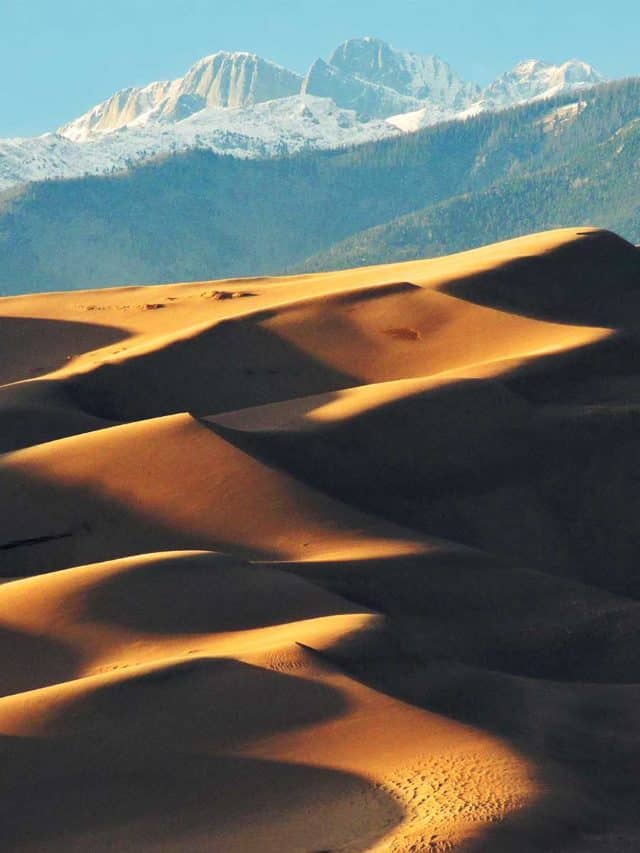
The sand dunes in the park were formed over thousands of years as winds blew sand from the nearby San Luis Valley and deposited it in the park. The dunes range in height from about 30 feet to over 750 feet tall, and they cover an area of about 30 square miles.
The park is located in the San Luis Valley, which is surrounded by the Sangre de Cristo Mountains to the east and the San Juan Mountains to the west. The landscape is diverse, with forests of pine and spruce trees, grasslands, and wetlands. The park is also home to a wide variety of plant and animal life, including mule deer, bighorn sheep, and pronghorn.
There are many ways to explore and enjoy Great Sand Dunes National Park. Visitors can go sandboarding or sand sledding on the dunes, go hiking or biking on the park’s trails, or even go fishing or birdwatching in the park’s wetlands. There are also several campgrounds located within the park, providing comfortable accommodations for visitors.
Great Sand Dunes National Park is a unique and beautiful place, offering visitors the opportunity to experience the beauty and majesty of the natural world in a truly special setting. It is a great destination for park lovers, with plenty of opportunities for sand sports, hiking, and other outdoor activities.

These 12 Colorado National Parks Will Blow Your Mind
- Location: Colorado
- Acreage: 149,000 acres
- Visitation: Over half million visitors annually.
- Elevation: The elevation within the park and preserve ranges from a low of 7,520 feet (near San Luis Lakes ) to a high of 13,604 feet above sea level (Tijeras Peak) – a difference of 6,084 feet! The elevation at the Visitor Center is 8170 feet.
- Average annual precipitation: The Great Sand Dunes receive an average annual precipitation of 11 inches including an average snowfall of 37 inches.
- When Did It Become A National Park? The park was originally established as Great Sand Dunes National Monument on March 17, 1932 by President Herbert Hoover. Congress authorized a boundary change and re-designation as a national park in 2004.
1. The Oldest Evidence Of Humans In The Area Dates Back 11,000 Years
If you’re interested in origin stories then you’ll likely appreciate the first of our Great Sand Dunes National Park Facts. The oldest evidence of humans in the area dates back to about 11,000 years. Now that’s old!
The National Park Service states that the first people to enter the San Luis Valley and the Great Sand Dunes area were nomadic hunters and gatherers who were attracted to the area because of the herds of mammoths and prehistoric bison that grazed nearby.
These people, who lived during the Stone Age, hunted with large stone spear or dart points, which are now identified as Clovis and Folsom points.
They likely entered the San Luis Valley on foot, and spent time there when hunting and gathering plants was bountiful, but avoided the area during times of drought and scarcity.
These ancient people were part of a long tradition of human inhabitants in the region, and their artifacts and tools provide valuable insights into the lives and culture of the people who lived in the area during this time period.

2. Great Sand Dunes Features The Largest Sand Dune In North America
One of my favorite Great Sand Dunes National Park Facts has to do with the size of the sand dunes.
Star Dune is one of the tallest dunes in North America, tied with Hidden Dune at 741 feet from base to summit.
To reach the summit of Star Dune, visitors can take a hike from the summit of High Dune on First Ridge, or they can access the base of the dune along the Medano Creek bed.
The hike from the Dunes Parking Lot is about 2 miles south down the Medano Creek bed, and once the massive pyramid-shaped Star Dune comes into view, visitors can follow a ridge to its summit.
Visitors are allowed to climb and explore any part of the 30 square mile dune field, but it’s recommended to do so in the early mornings or evenings to avoid the high surface temperatures during the summer.
3. At Great Sand Dunes, You Can See Sand That Moves
Now here’s one of those truly fascinating Great Sand Dunes National Park Facts. At Great Sand Dunes, you can actually see sand that moves. Believe it or not!
The traditional Ute word for the Great Sand Dunes is Saa waap maa nache, which means “sand that moves.”
Though the locations of the larger dune forms have remained fairly constant for centuries, some smaller dunes may grow and migrate across grasslands.
I’m a retired history teacher, but perhaps a quick science lesson is in order. Sand dunes move forced by wind through different mechanisms. They can move through a mechanism known as “saltation”, where the particles of sand are removed from the surface and are carried by the wind, before landing back to the surface.
The end result of this process is that you watch as the sand literally moves before your eyes. Check it out. It’s amazing!

Facts About Badlands National Park
In 2019, Great Sand Dunes became a certified International Dark Sky Park by the International Dark Sky Association. What this means is that the park’s rare combination of dry air, little light pollution and high elevation makes it perfect for viewing stars.
The Milky Way is most visible over moonless nights from mid-summer through early fall evenings. Visitors also hike the dunes at night, once the temperatures have cooled off from the hot summer’s day.
To see the most stars, plan your visit for moonless nights, or nights with a late moonrise. Or, plan your visit on the full moon when it’s bright enough for a surreal walk on the dunes.
Great Sand Dunes offers summer night programs for adventurers of all ages. Be sure to check the program schedule during summer months.
Facts About Big Bend National Park
5. The Park Is Susceptible To Extreme Temperatures
This next Great Sand Dunes National Park Fact is especially important if you’re planning to travel to the park. If you are then be sure to wear sunscreen and protective clothing during any time of the year.
Sand surface temperatures peak at 150°F (65 degrees C) on a sunny summer afternoon and drop to -20°F (-29 degrees C) on a winter’s night.
It is recommended to wear sturdy and closed footwear year round to protect yourself from the elements.
In January, snow falls on the dunes about once per week. During this quiet season, elk and pronghorn are often spotted in the early mornings.

Facts About Canyonlands National Park
6. We Don’t Know How Old The Sand Dunes Are
Just when you thought we couldn’t come up with any more unbelievable Great Sand Dunes National Park Facts we’ve come up with another one. We simply don’t know how old these sand dunes are.
According to the National Park Service, scientists don’t yet have a precise age and estimates have changed over time. At one time they were thought to be very young and the result of glacial outwash. We have since learned that the dune sand extends hundreds of feet into the subsurface, so they are actually older than initially believed.
The dune sand begins just above the clay deposits of Lake Alamosa, so if Lake Alamosa disappeared about 440,000 years ago, then there have been dunes here since then. It’s also possible that there is more dune sand under the lake deposits.

We haven’t drilled that deep yet. Keep in mind that the dunes we see today are young and may have come from glacial outwash as recently as 12,000 years ago that flooded the modern playa system.
The best answer is the dunes on the surface are young as they are constantly forming, but since the sand goes deep into the subsurface, there have been dunes here for a long time.

Facts About Capitol Reef National Park
7. You Could Find Fossils At The Park
Now here’s another amazing Great Sand Dunes National Park Fact. You could actually discover a fossil while visiting.
Prehistoric treasures have been found in the park. The Columbian Mammoth, even larger than its well known cousin the Woolly Mammoth, had teeth the size of a human head and once roamed the area.
Thousands of years ago the desert valley was covered with large lakes and rich plant life. This is an excellent habitat for a mammoth because they needed to eat over 700 pounds of vegetation each day.
So it’s quite possible that you could find the prehistoric remains of one of these amazing creatures although it’s best if you don’t promise family or friends any special souvenirs. It’s better to wait and surprise them.
CHECK OUT: 15 (Fascinating) Death Valley National Park Facts You Probably Didn’t Know
8. Visitors Can Surf At Great Sand Dunes
Surf’s up! One of the coolest of the Great Sand Dunes National Park Facts is that you hang ten and surf the ocean on these sandy slopes.
At Great Sand Dunes, you can sand board or sand sled. Sand boards and sand sleds are specifically made for sand, featuring a special design with extra slick base material and special wax; these work best for sliding in most conditions.
Be advised, however, that the National Park Service does not rent the gear necessary. Specially designed sand boards and sand sleds may be rented or purchased at retailers in the San Luis Valley, which is nearby.

Where Can I Sand Board Or Sand Sled?
According to the National Park Service, sand boarding, sledding, and skiing are permitted anywhere on the dune field away from vegetated areas.
From the main Dunes Parking Area, it’s a minimum 0.7 mile hike to get to the small or medium-sized slopes; the top of the first high ridge is 1.25 miles.
Smaller slopes at the base are fine for young children, while teens and adults may prefer longer slopes near the top of the first high ridge of dunes.

Plan your dunes time for early morning or evening during summer to avoid a 150 degree F sand surface or thunderstorms. In spring and fall, sand temperatures are usually moderate throughout the day, but spring afternoons can be very windy.
Now here’s one of the lesser known of the Great Sand Dunes National Park Facts. It’s more than just sand.
There are actually forested hiking trails at the park. These trails include the following:
- Montville Nature Trail: In summer, keep this hike as an option for afternoon as an escape from the heat of the dunes. Walk along a shady forested trail named for a late 1800s settlement, comprising 20 houses back in the day. Rest near the trail’s high point, where you’ll find outstanding views of Mt. Herard, the dunes and the valley.
- Mosca Pass Trail: This trail follows a small creek to the summit of a low pass in the Sangre de Cristo mountains, winding through aspen and evergreen forests. Allow 2-3 hours to reach the pass; the trail is 3 1/2 miles one way. American Indians and early settlers used this route for travel into the valley.
- Sand Ramp Trail: This 11 mile trail is most commonly used as an access to various backpacking sites along the foothills, rather than as a destination trail for scenery, since it stays at the same elevation along the base of the mountains. Begin hiking the Sand Ramp Trail in Loop 2 of the campground or at Point of No Return Parking area. After the first two miles, much of this trail is sandy soil or pure sand, up and down along the foothills, so this hike can be grueling. Allow for more time than the mileage indicates. (Source: NPS)

10. The Sand Sings At Great Sand Dunes
My favorite of the Great Sand Dunes National Parks Facts has to do with the sand itself. Not only does it move. It sings too!
Just as our own voices are made by air moving through vibrating vocal chords, a humming sound is made at Great Sand Dunes as air is pushed through millions of tumbling sand grains during an avalanche.
Avalanches occur naturally during storms, but can also be created by people pushing sand down a dune face.
In the 1940s, one of Bing Crosby’s musical hits was “The Singing Sands of Alamosa” – a love song based on the sounds made by the Great Sand Dunes.

11. Great Sand Dunes Has An Amazing Variety Of Wildlife
Now here’s one of our most surprising Great Sand Dunes National Park Facts. For a park which resembles the Great Sahara Desert, Great Sand Dunes has an amazing variety of wildlife.
This wildlife includes:
- Ord’s kangaroo rats whichcan live their entire lives in the dunefield.
- Mule deer which are the most commonly observed mammal at the park.
- Black bears that are most often near riparian areas, where they find an abundance of plants and small animals to eat.
- Abert’s squirrels that are jokingly referred to as “scrabbits” because of their rabbit-like ears.
- Mountain lions which are rarely seen by park visitors, but their tracks are often seen along Medano Creek and Sand Creek, where they hunt mule deer at night.
- Pronghorn which can run at speeds up to 60 mph (97kph) across the park’s grasslands. Visitors sometimes see a herd of pronghorn along the park entrance road in morning or evening.
Over 250 species of birds have been documented at Great Sand Dunes National Park and Preserve. In summer months, many species nest here in tundra, forests, grasslands, or wetlands.
View a Checklist of Birds of the park and preserve.

We’re Jim Pattiz and Will Pattiz, collectively known as the Pattiz Brothers (and sometimes the Parks Brothers) and we absolutely LOVE the national parks.
You should probably know that we don’t just make this stuff up out of thin air. We’ve spent our entire adult lives exploring and filming America’s national parks and public lands.
We’ve worked with the National Park Service, the Department of Interior, USDA, and the U.S. Forest Service for years creating films on important places and issues. Our work has been featured in leading publications all over the world and even some people outside of our immediate family call us experts on the national parks.
Meet The Parks Brothers
- The Oldest Evidence Of Humans In The Area Dates Back 11,000 Years
- Great Sand Dunes Features The Largest Sand Dune In North America
- At Great Sand Dunes, You Can See Sand That Moves
- Great Sand Dunes Is An International Dark Sky Park
- The Park Is Susceptible To Extreme Temperatures
- We Don’t Know How Old The Sand Dunes Are
- You Could Find Fossils At The Park
- Visitors Can Surf At Great Sand Dunes
- There Are Forested Hiking Trails At Great Sand Dune
- The Sand Sings At Great Sand Dunes
- Great Sand Dunes Has An Amazing Variety Of Wildlife
We Hope You’ll Follow Our Journey

Our goal here at More Than Just Parks is to share the beauty of America’s national parks and public lands through stunning short films in an effort to get Americans and the world to see the true value in land conservation.
We hope you’ll follow our journey through the parks and help us to keep them the incredible places that they are. If you’re interested joining the adventure, sign up below!
Helpful Related Articles
Rocky Mountain National Park Guide: Rocky Mountain National Park: An Epic Guide to Colorado’s Alpine Gem
Rocky Mountain National Park Hikes: 18+ Epic Rocky Mountain National Park Hikes (+ Photos)
Colorado National Parks: These 4 Colorado National Parks Will Blow Your Mind (Helpful Guide)
National Parks Near Denver: National Parks Near Denver You’ll Love
Things to Do Great Sand Dunes: 15 Best Things to Do at Great Sand Dunes National Park
Things to Do Rocky Mountain: Things to Do at Rocky Mountain National Park
Black Canyon of the Gunnison Facts: Facts About Black Canyon of the Gunnison National Park
Frequently Asked Questions About Great Sand Dunes National Park
When is the best time to visit Great Sand Dunes?
The best time to visit Great Sand Dunes National Park is Late April through June, September through October. Conditions vary significantly by season, so plan accordingly and check current conditions before your trip.
How much does it cost to enter Great Sand Dunes National Park?
The entrance fee for Great Sand Dunes National Park is $25 per vehicle (valid for 7 days). An America the Beautiful Annual Pass ($80) covers entrance to all 63 national parks and 2,000+ federal recreation sites.
What is Great Sand Dunes known for?
Great Sand Dunes National Park is known for Tallest dunes in North America, Medano Creek seasonal beach, Sandboarding and sand sledding, and Dark sky stargazing. The park spans 107,342 acres and was established in 2004.
What are the best things to do at Great Sand Dunes National Park?
The top activities at Great Sand Dunes include Dune hiking, Sandboarding and sand sledding, Medano Creek wading, Stargazing, Backpacking, and Wildlife watching. Check our Great Sand Dunes guide for detailed recommendations.
Where is Great Sand Dunes National Park located?
Great Sand Dunes National Park is located in Colorado. Visit our complete Great Sand Dunes guide for directions, nearby airports, and getting-there tips.
What to Bring to Great Sand Dunes
Gear we recommend for Great Sand Dunes. Affiliate links support our work at no cost to you.
Affiliate disclosure: Some links on this page earn us a small commission at no extra cost to you. We only recommend gear we actually use.